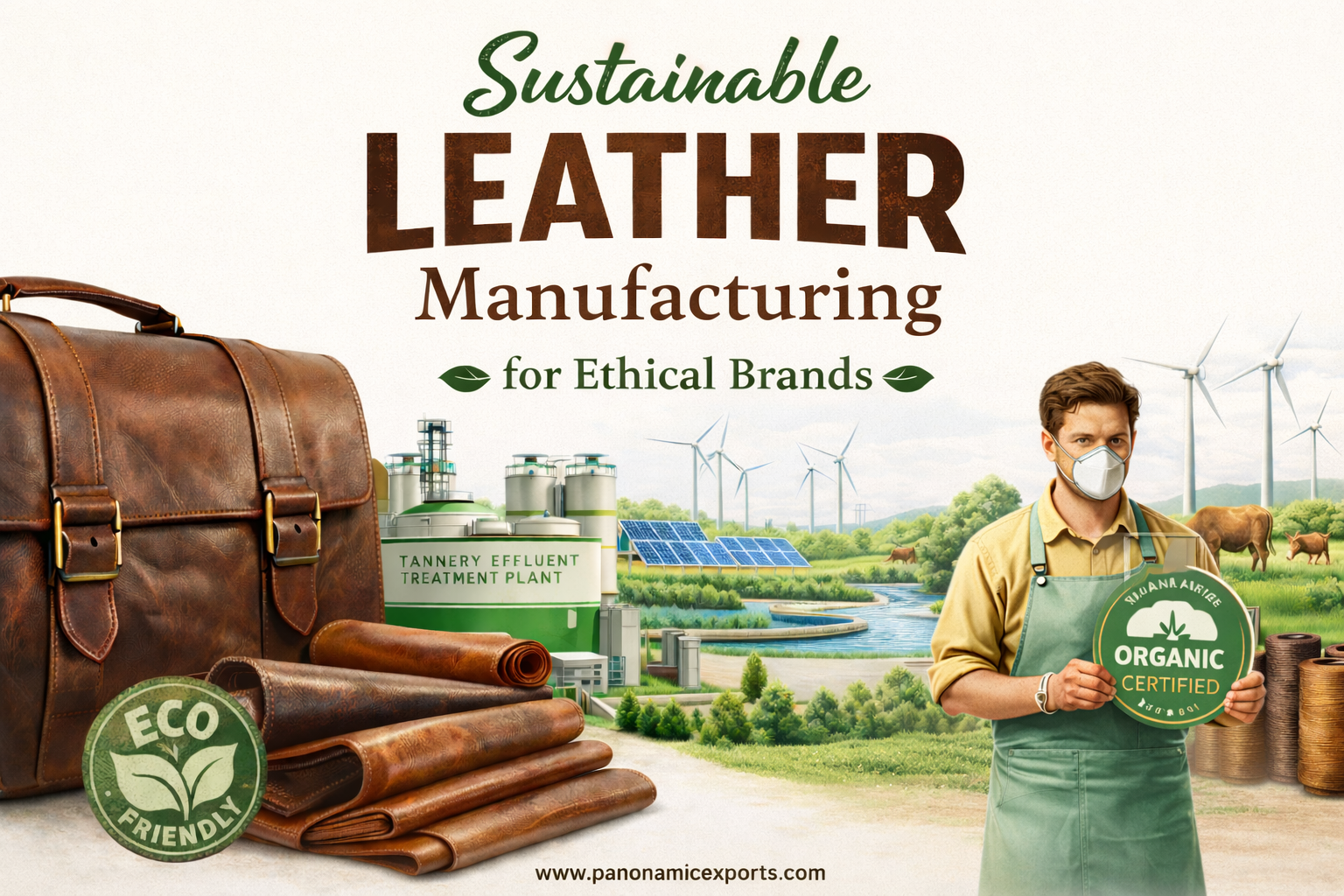
Sustainable Leather Manufacturing for Ethical Brands
The world of fashion has been at a cross road with transparency as the new luxury. To a contemporary designer, Sustainable Leather Manufacturing has ceased being a bonus and has become a business necessity. Since consumers in the USA, UK and EU require increased accountability, ethical brands are moving towards manufacturing approaches that respect the environment without abandoning the everlasting quality of high-quality leather.
In Panoramic Exports, we have taken years to perfect our supply chain to such high standards. When we become sustainable in our approach towards leather production, we are confident that our leather handbags, wallets and accessories will be a bridge between the artisan tradition and environment friendly production in the future.
The Development of Sustainable Leather Production
Conventionally, the leather industry was condemned to consume vast amount water and tanning processes that were chemical intensive. Nevertheless, the year 2026 is characterized by technological revolution. The current sustainable production of leather incorporates the latest advances in the field of biotechnology and closed-loop systems in order to reduce wastes.
1. The Change to Vegetable Tanning
The application of natural tannins is one of the foundations of the Sustainable Leather Manufacturing. Rather than using chromium salts which are poisonous unless properly managed, vegetable tanning makes use of extracts of oak, chestnut and mimosa trees. The end result is a biodegradable material that forms a rich patina with time, which is a characteristic of luxury with ethical brands.
2. Water Stewardship and ZLD Technology
Water is an expensive commodity and ecological lean production of leather should be used wisely. Indian major tanneries are also beginning to use Zero Liquid Discharge (ZLD) technology. This is a system that ensures that all the water consumed in the tanning process is treated and recycled into the production line and therefore, there is no run off that is hazardous to the local ecosystems.
Ethical Brands Strategic Pillars
To become a truly ethical brand, one has to consider a brand not only in terms of the final product but also of the lifecycle of the material. Development of Sustainable Leather Manufacturing is based on various strategic pillars that are concerned with long term sustainability.
1. Ethical Supplies of Raw Materials
The initial process in the sustainable leather manufacturing is making sure that the hides are the byproduct of the food industry. We will only deal with suppliers that are able to offer traceability so that none of the cattle is reared to give them hides and that the leather is not the cause of deforestation in vulnerable areas.
2. Chemical Management and REACH Compliance
One of the main aims of the sustainable leather production is the removal of limited substances. We strictly adhere to the requirements of REACH in our production processes, i.e. our production processes do not contain Lead, Cadmium or Azo dyes. This is not only concerning the environment it is also concerning the safety of the individuals working in the factory and the final consumers who wear the products.
3. Production Energy efficiency
To achieve sustainable leather manufacturing, the carbon footprint should be decreased. Most of our partner plants have shifted to solar and high efficiency machine to drive the stitching and finishing of the leather bags and wallets.
Production of Eco-Leathers: The Animal Hide Replacement
Even though the traditional leather is still in use, the Sustainable Leather Manufacturing today comprises multiple alternatives of the so-called eco-leather. These materials provide the same feel with recycled or vegetable materials.
1. Recycled Leather: It is the process of grinding offcuts in leather and bonding them to natural fibers. It is one of the most important aspects of sustainable manufacture of leather as it minimizes the wastes in landfills.
2. Bio-Based Coatings: We are erring towards petroleum-based finishes and use water-based polyurethane and natural oils to provide our leather items with their trademark look and longevity.
International Certifications: The Mark of Integrity
Certifications serve as a mediator of trust between the manufacturer and the brand in the Sustainable Leather Manufacturing world. Ethical brands are supposed to make partners with the following requirements:
1. LWG (Leather Working Group): An environmental audit of tanneries on a gold standard.
2. SEDEX/SMETA Compliance: We are also proud to be a SEDEX compliant company and thus our manufacturing process of sustainable leather not only protects the rights and health of the labor but also covers the manufacturing process.
3. ISO 14001: This confirms our belief in a good environmental management system.
Economic Benefits of Selecting Sustainability
Other brands are even afraid that sustainable leather manufacturing would carry a high prohibitive price. Nevertheless, in the long-term economic terms, the total costs are usually immersed in the long-term economic benefits.
1. Brand Loyalty: As long as products correspond to the values of the consumer, they are ready to pay more.
2. Regulatory Readiness: With the newly implemented EU directive on sustainable leather production called the Green Claims, your brand will always be ahead of the legal needs.
3. Longevity of the Products: Sustainable leather products tend to be stronger and thus less frequent returns and higher customer satisfaction.
Excellence in Manufacturing with Panoramic Exports
At Panoramic Exports, we are not in the business of taking orders but a consultant to your brand on its ethical path. Our business insights and skills in making our leather products sustainable are oriented on luxury leather tote bags and handbags, high-quality men wallets, handmade belts and travel accessories, which demand and remain in high demand.
We take care of the details of the exporting paperwork of leather and at the same time show that everything in your shipment is on the most environmentally friendly standards of 2026. By selecting our sustainable leather production services, you are able to get a curated list of Indian artisans who value the craft and the planet.
Conclusion
It is certainly green in the future of fashion. A process that has allowed the ethical brands to remain able to provide the prestige of leather and still deliver on their promises of environmental sustainability is Sustainable Leather Manufacturing. Further on into 2026, the brands that do flourish will be those that make the principle of transparency, chemical safety and waste reduction the main part of themselves.
We will guide you on this transition at Panoramic Exports. Since the beginning of finding the appropriate hides to manufacture a sustainable leather product, to the end- quality check, we will make sure that your process of manufacturing leather sustainability products will be smooth, compliant and profitable.
FAQs
1. Is a more expensive sustainable leather production?
Although the unit price might slightly increase with the production of organic tannins and water treatment, eco-friendly leather production will add a considerable brand value to the product and decrease potential regulatory risks in the long-term.
2. What can I do to demonstrate to my consumers that my leather is sustainable?
You are able to offer LWG audit ratings and REACH compliance certificates. Such partners as Panoramic Exports supply all the documentation needed to support you.
3. What is vegan leather and sustainable leather?
Vegan leather is made of plants or synthetic (no animal hides) and sustainable leather manufacturing involves animal hides turned into byproducts and manufactured by environmentally friendly and natural procedures.
4. Can I get custom designs with sustainable leather?
Absolutely. We specialize in private-label sustainable leather manufacturing for handbags, wallets and belts tailored to your brand’s specific aesthetic.
5. What are the most common eco-friendly tanning methods?
The most popular method in sustainable leather manufacturing is Vegetable Tanning, which uses tree barks and natural extracts instead of heavy metals.
Leave a Reply