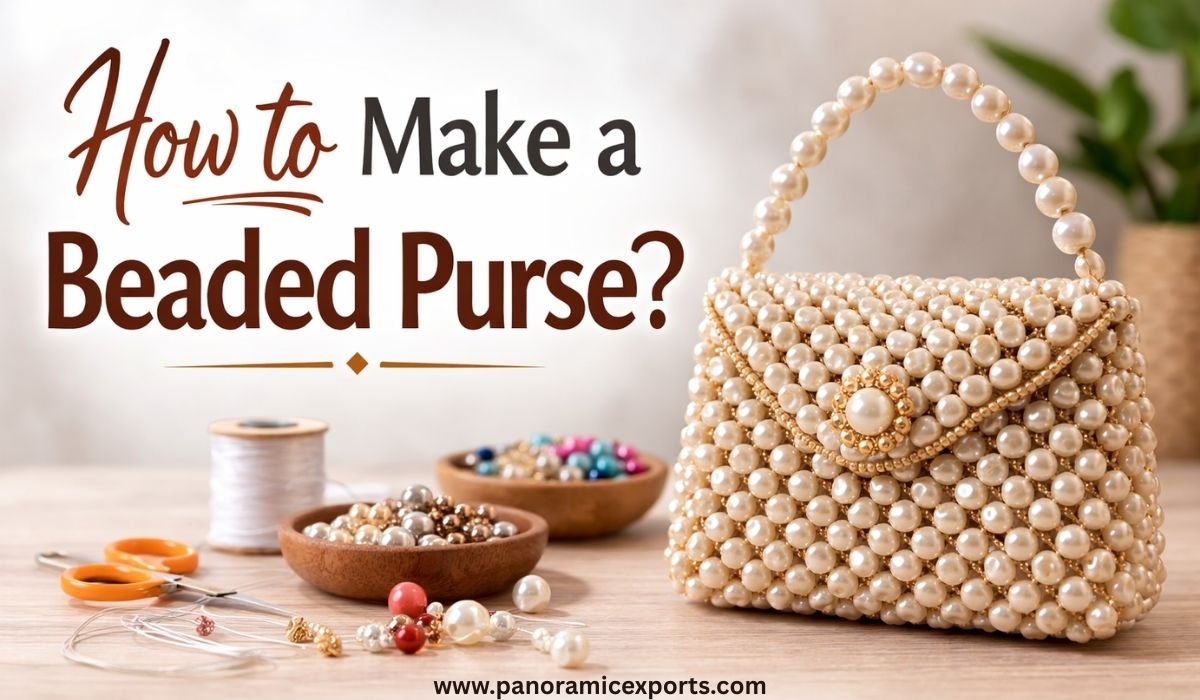
How to Make a Beaded Purse?
Look, making a Beaded Purse is basically a marathon for your fingers. It’s the trend that won’t quit because these items have a tactile, heavy soul that plastic-molded fast fashion can’t touch. But don’t let the pretty colors fool you—this is structural work. If you don’t get the physics right, you’re just making an expensive pile of loose beads. A real Beaded Handbag is all about one thing: tension.
It’s about that raw, sore-thumb feeling after four hours of pulling nylon tight. You’re fighting the material the whole time. If you go soft on the line for even a second, the whole bag loses its “bones” and starts to sag like an old sweater. You want a Beaded Purse that feels like a solid brick in your hand—something that clacks with authority when you set it down on a glass table. That only happens when you commit to the grind and respect the friction between the spheres.
The Physics of the Build
Stop thinking like a jeweler. Start thinking like a mason. You’re laying bricks, not stringing a necklace. If the foundation is weak, the whole Beaded Handbag folds the second you put a heavy wallet in it. The entire structure relies on a geometric system called the Right Angle Weave, a cross-locking beadwork method that creates strong, structured surfaces in purse construction. You can understand the technical weaving process in detail by reading this guide on Right Angle Weave technique.
Picking Your “Main Character”
The character of your Beaded Purse starts with the material. Acrylics are the go-to for that chunky, 90s-style vibe. They’re light enough that you won’t get a shoulder ache. Glass or crystal is the play if you want that high-end “clink” when the bag hits the table. I always suggest 10mm rounds for a standard purse. If you go smaller for your first project, you’ll probably throw the whole thing out the window by hour three. The weight of the bead matters because it provides the gravity needed to keep the weave seated properly.
Essential Tools and Materials for Making a Beaded Purse
Forget the stretchy cord from the craft aisle. It’s useless for a Bead Purse. You need 0.5mm to 0.6mm clear nylon monofilament. It’s fishing line, basically. It doesn’t stretch and it’s tough as nails. You’ll also need about 1,200 beads—overbuy, because you’ll lose ten under the couch. And get a pair of flush-cut snips. You need to bury the knots inside the beads so they don’t scratch your hands or snag on a silk dress.
The Construction Reality: How to Make a Beaded Purse?
We aren’t following a “tutorial” here; we’re following a blueprint. The construction of a beaded purse is a non-linear process that happens in three specific structural planes.
Constructing the Floor
The base of your beaded purse dictates the entire silhouette. You start by threading four units onto your line and crossing the ends to create a “cell.” By repeating this horizontally, you create the floor. This section must be exceptionally tight, as it bears the brunt of the interior weight. If the floor of your beaded handbag is soft, the walls will collapse inward the moment you pick it up.
Rising Vertically
To move from a flat mat to a three-dimensional beaded purse, you have to pivot. You “link” into the side units of your floor and begin building the walls. This is where the bag starts to gain its characteristic rigidity. If your tension is uneven here, the bead handbag will lean. It’s a slow-motion battle against the tangling of lines and the limits of human finger strength. You’re fighting the material the whole time.
The Kinetic Stress Points
The handle and closure are where most DIY efforts fail. To prevent a snap, you have to weave the handle directly into the grid of the beaded purse, distributing the weight across the entire frame. This “deep-root” weaving is what makes a professional beaded handbag last for decades rather than weeks.
Industrial Excellence: The Panoramic Exports Standard
While individual crafting is a slow, meditative process, the global market demands a level of consistency that is difficult to achieve in a home setting. This is the niche occupied by Panoramic Exports. As a specialist in the manufacturing and distribution of artisanal goods, our company bridges the gap between traditional Indian hand-weaving and the rigorous demands of international fashion houses.
At Panoramic Exports, we don’t just “make” things; we manufacture them to withstand the real world. Every Beaded Purse produced by our team undergoes a specific tension-test to ensure the weave is uniform across every square inch. We focus on “Invisible Finishing,” a technique where knots are buried deep within the sphere cores to prevent skin irritation. For boutiques and wholesalers, partnering with our company means access to a level of craftsmanship where every single bead is accounted for. We handle the heavy lifting of production so that the final Beaded Handbag hits the retail shelf with perfect symmetry.
Conclusion
The journey of creating a Beaded Purse is a grueling exercise in focus. It is a slow, methodical grind where one missed loop can compromise the entire structure. From the initial layout of the base to the final reinforcement of the straps, making a Bead Purse is about honoring the material and the clock. It’s one Bead, one cross-stitch and one pull at a time. Whether you’re trying to DIY your own signature piece or you’re a brand looking for the massive scale that Panoramic Exports provides, you have to respect the hours that go into every single weave. It’s slow fashion at its best.
This isn’t just about throwing together a quick purse; you’re actually building something with enough grit and personality that it refuses to be ignored. When you finally tuck in that last knot and cut the line, you’re holding a solid piece of work that isn’t going to fall apart or look dated by next season. It’s that raw, hand-cramping effort—the kind you can’t fake—that gives a Beaded Purse its real soul in a world that’s already overflowing with hollow, mass-produced junk.
FAQs
1. Which thread is strongest for a Bead Purse?
A clear, non-stretch nylon fishing line (0.6mm) provides the best mix of strength and invisibility for a Beaded Purse.
2. How many beads does it take to finish a Bead Purse?
Depending on the size, you can expect to use anywhere from 1,200 to 1,500 beads for a standard beaded purse.
3. How do I fix a loose row in my bead purse?
You can’t just “tighten” it from the outside; you usually have to unweave and restart that section of the beaded purse to fix the tension.
4. Is a beaded purse waterproof?
The beads and nylon are waterproof, but you should dry a Beaded Handbag thoroughly to prevent moisture from weakening the internal line.
5. Does Panoramic Exports handle custom purse designs?
Yes, Panoramic Exports works closely with global designers to manufacture specific, high-quality purse patterns for international markets.
Leave a Reply