Category: Uncategorized

  • Leather Bag Manufacturer in India for Global Brands

    Leather Bag Manufacturer in India for Global Brands

    Leather Bag Manufacturer in India for Global Brands

    The international fashion community is experiencing a drastic change in sourcing and specialization is the key focus of this trend and the search for the perfect Leather Bag Manufacturer India. For brands in Europe, North America and Australia, India is not only about the opportunity to find a cheaper substitute, but it is also about a pool of craftsmanship and quality raw materials. Nevertheless, in order to operate a collection into the market successfully, a brand should be aware of the logistical complexity of a leather bag factory India and the way to capitalize on the manufacturing advantages that the country has to offer.

    At Panoramic Exports, we are the leading manufacturer of leather bags in India that is a strategic business partner of brands requiring excellence. It is not just another leather bag factory in India, it is a place of innovation where old school leather craft collides with new industrial performance.


    Why the World is Turning to a Leather Bag Manufacturer India

    The vertical integration of the industry is the competitive edge of the Leather Bag Manufacturer India. India boasts a huge number of livestock, which serves as a reliable source of cow and buffalo hides. When you deal with a leather bag manufacturer India, you are dealing with materials that have been processed in some of the most well-known tanneries in the world.

    The leather bag factory India is also enjoying a specialized workforce. The art of hand-skiving and edge-painting, as practiced in provinces such as Kanpur and West Bengal, was mastered by artisans over generations and is frequently lost in extremely automated western factories. This sense of human touch is what enables a leather bag producer India to make products that have a soulful, luxury feel to them.


    The Operational Excellence of a Leather Bag Factory India

    The leather bag factory India will need to be based on an organizational and technological base to be world-class. Our establishment, Panoramic Exports, is subdivided into specialized zones to make it as efficient as possible. This begins with the grading of leather where all the hides are examined to detect any scars or defects. In a luxury leather bag manufacturer India, only 10% of the hides will be used to create Full Grain leather.

    After the selection process, our leather bag factory India employs the process of precision cutting, through traditional dies or modern CNC laser cutters, to make sure that all the panels are flawless. We, as a top India leather bag company, know that the structure of a bag is made from the bones of the bag. The handles and bases of our office portfolio bags and backpacks are reinforced with high-quality materials so that they will never lose their shape even after many years of usage.


    Diverse Capabilities: From Handbags to Duffles

    Being a universal Leather Bag Manufacturer India, our production possibilities are enormous. We have a leather bag factory in India which focuses on:

    • Professional Office Bags: Smooth portfolio bags and laptop covers that are made to suit the businessman.
    • Travel Gear: Heavy leather duffle bags and backpacks that are ergonomic and can take the stress of international travel.
    • Luxury Handbags: Modern ladies handbags that are designed for trend setters with high-quality finishes.

    Each category of products of our leather bag factory India has a separate team who is aware of the stresses and design needs of that particular product. For example, our duffle bags have been sewn using nylon thread of high tensile strength which is generally used in an export-oriented leather bag manufacturer India.


    Sustainability and the Modern Leather Bag Factory India

    A leather bag producer in India should also be a guardian of the environment in the 2020s. The contemporary consumer is very sensitive to the environmental impact of what he or she buys. Our leather bag factory India focuses on using vegetable-tanned leather and water-based adhesives. By selecting a leather bag producer in India which invests in environmentally-friendly production, brands can safely sell their items to the increasing population of conscious consumers. Global sustainability standards for leather manufacturing can be explored at Leather Working Group.

    Moreover, being an export-ready leather bag factory India, our establishment is a safe, well-ventilated factory that fully complies with international labor laws. In our eyes, the quality of a bag is the direct expression of the well-being of the person making the bag.


    The Panoramic Exports Promise

    The difference that makes us stand out as a Leather Bag Manufacturer India is our adherence to the Total Quality philosophy. Most factories are capable of sewing a bag, but not all have the ability to handle the whole process of exporting. Our leather bag factory India offers end-to-end management of designs as soon as they leave your desk up to the time of loading the containers at the port. We manage the sampling, strict 5-point quality checks and all the reports needed for export.

    As a leather bag manufacturer India, we understand what it means to be a custodian of a brand reputation. We do not consider ourselves only a leather bag factory India at Panoramic Exports; we view ourselves as the architects of the future of your brand. Whether you need 50 handmade duffles or 5,000 office bags, we have the space and the desire to perform the task.


    Conclusion

    The process of transforming leather into a luxury item in a boutique is a transformational one. It starts with a raw hide in a tannery and evolves into a fashionable product. By making the correct selection of a Leather Bag Manufacturer India, one can be certain that this change will be carried out carefully, accurately and professionally. In Panoramic Exports, you are selecting a leather bag factory India that is committed to the best of worldwide business. We can make your designs more than they can be with the strength of Indian manufacturing.


    FAQs

    1. Why will I select a leather bag company in India for my brand?
    India presents an exclusive combination of indigenous leather of high quality and craftsmanship at a competitive price target.

    2. What is the order quantity of a leather bag factory in India?
    The average export-ready factories will have a minimum as well as a maximum number of units required per style to maintain production efficiency.

    3. Is there eco-friendly leather in a Leather Bag Manufacturer India?
    There are many manufacturers of sustainable brands, including us, who provide vegetable-tanned and chrome-free leather.

    4. What about shipping from a leather bag factory India?
    We liaise with international freight forwarders to arrange sea or air delivery directly to your destination.

    5. Is it possible to have custom designs from a leather bag company India?
    Yes, we manufacture private label products by transforming sketches into completed and branded items.
  • Sustainable Leather Manufacturing for Ethical Brands

    Sustainable Leather Manufacturing for Ethical Brands

    Sustainable Leather Manufacturing for Ethical Brands

    The world of fashion has been at a cross road with transparency as the new luxury. To a contemporary designer, Sustainable Leather Manufacturing has ceased being a bonus and has become a business necessity. Since consumers in the USA, UK and EU require increased accountability, ethical brands are moving towards manufacturing approaches that respect the environment without abandoning the everlasting quality of high-quality leather.

    In Panoramic Exports, we have taken years to perfect our supply chain to such high standards. When we become sustainable in our approach towards leather production, we are confident that our leather handbags, wallets and accessories will be a bridge between the artisan tradition and environment friendly production in the future.


    The Development of Sustainable Leather Production

    Conventionally, the leather industry was condemned to consume vast amount water and tanning processes that were chemical intensive. Nevertheless, the year 2026 is characterized by technological revolution. The current sustainable production of leather incorporates the latest advances in the field of biotechnology and closed-loop systems in order to reduce wastes.

    1. The Change to Vegetable Tanning

    The application of natural tannins is one of the foundations of the Sustainable Leather Manufacturing. Rather than using chromium salts which are poisonous unless properly managed, vegetable tanning makes use of extracts of oak, chestnut and mimosa trees. The end result is a biodegradable material that forms a rich patina with time, which is a characteristic of luxury with ethical brands.

    2. Water Stewardship and ZLD Technology

    Water is an expensive commodity and ecological lean production of leather should be used wisely. Indian major tanneries are also beginning to use Zero Liquid Discharge (ZLD) technology. This is a system that ensures that all the water consumed in the tanning process is treated and recycled into the production line and therefore, there is no run off that is hazardous to the local ecosystems.


    Ethical Brands Strategic Pillars

    To become a truly ethical brand, one has to consider a brand not only in terms of the final product but also of the lifecycle of the material. Development of Sustainable Leather Manufacturing is based on various strategic pillars that are concerned with long term sustainability.

    1. Ethical Supplies of Raw Materials

    The initial process in the sustainable leather manufacturing is making sure that the hides are the byproduct of the food industry. We will only deal with suppliers that are able to offer traceability so that none of the cattle is reared to give them hides and that the leather is not the cause of deforestation in vulnerable areas.

    2. Chemical Management and REACH Compliance

    One of the main aims of the sustainable leather production is the removal of limited substances. We strictly adhere to the requirements of REACH in our production processes, i.e. our production processes do not contain Lead, Cadmium or Azo dyes. This is not only concerning the environment it is also concerning the safety of the individuals working in the factory and the final consumers who wear the products.

    3. Production Energy efficiency

    To achieve sustainable leather manufacturing, the carbon footprint should be decreased. Most of our partner plants have shifted to solar and high efficiency machine to drive the stitching and finishing of the leather bags and wallets.


    Production of Eco-Leathers: The Animal Hide Replacement

    Even though the traditional leather is still in use, the Sustainable Leather Manufacturing today comprises multiple alternatives of the so-called eco-leather. These materials provide the same feel with recycled or vegetable materials.

    1. Recycled Leather: It is the process of grinding offcuts in leather and bonding them to natural fibers. It is one of the most important aspects of sustainable manufacture of leather as it minimizes the wastes in landfills.

    2. Bio-Based Coatings: We are erring towards petroleum-based finishes and use water-based polyurethane and natural oils to provide our leather items with their trademark look and longevity.


    International Certifications: The Mark of Integrity

    Certifications serve as a mediator of trust between the manufacturer and the brand in the Sustainable Leather Manufacturing world. Ethical brands are supposed to make partners with the following requirements:

    1. LWG (Leather Working Group): An environmental audit of tanneries on a gold standard.

    2. SEDEX/SMETA Compliance: We are also proud to be a SEDEX compliant company and thus our manufacturing process of sustainable leather not only protects the rights and health of the labor but also covers the manufacturing process.

    3. ISO 14001: This confirms our belief in a good environmental management system.


    Economic Benefits of Selecting Sustainability

    Other brands are even afraid that sustainable leather manufacturing would carry a high prohibitive price. Nevertheless, in the long-term economic terms, the total costs are usually immersed in the long-term economic benefits.

    1. Brand Loyalty: As long as products correspond to the values of the consumer, they are ready to pay more.

    2. Regulatory Readiness: With the newly implemented EU directive on sustainable leather production called the Green Claims, your brand will always be ahead of the legal needs.

    3. Longevity of the Products: Sustainable leather products tend to be stronger and thus less frequent returns and higher customer satisfaction.


    Excellence in Manufacturing with Panoramic Exports

    At Panoramic Exports, we are not in the business of taking orders but a consultant to your brand on its ethical path. Our business insights and skills in making our leather products sustainable are oriented on luxury leather tote bags and handbags, high-quality men wallets, handmade belts and travel accessories, which demand and remain in high demand.

    We take care of the details of the exporting paperwork of leather and at the same time show that everything in your shipment is on the most environmentally friendly standards of 2026. By selecting our sustainable leather production services, you are able to get a curated list of Indian artisans who value the craft and the planet.


    Conclusion

    It is certainly green in the future of fashion. A process that has allowed the ethical brands to remain able to provide the prestige of leather and still deliver on their promises of environmental sustainability is Sustainable Leather Manufacturing. Further on into 2026, the brands that do flourish will be those that make the principle of transparency, chemical safety and waste reduction the main part of themselves.

    We will guide you on this transition at Panoramic Exports. Since the beginning of finding the appropriate hides to manufacture a sustainable leather product, to the end- quality check, we will make sure that your process of manufacturing leather sustainability products will be smooth, compliant and profitable.


    FAQs

    1. Is a more expensive sustainable leather production?

    Although the unit price might slightly increase with the production of organic tannins and water treatment, eco-friendly leather production will add a considerable brand value to the product and decrease potential regulatory risks in the long-term.

    2. What can I do to demonstrate to my consumers that my leather is sustainable?

    You are able to offer LWG audit ratings and REACH compliance certificates. Such partners as Panoramic Exports supply all the documentation needed to support you.

    3. What is vegan leather and sustainable leather?

    Vegan leather is made of plants or synthetic (no animal hides) and sustainable leather manufacturing involves animal hides turned into byproducts and manufactured by environmentally friendly and natural procedures.

    4. Can I get custom designs with sustainable leather?

    Absolutely. We specialize in private-label sustainable leather manufacturing for handbags, wallets and belts tailored to your brand’s specific aesthetic.

    5. What are the most common eco-friendly tanning methods?

    The most popular method in sustainable leather manufacturing is Vegetable Tanning, which uses tree barks and natural extracts instead of heavy metals.

  • Complete Leather Goods Export Process Explained

    Complete Leather Goods Export Process Explained

    Complete Leather Goods Export Process Explained

    There has been a paradigm shift in the Leather Goods Export Process in 2026 in India. International buyers have never considered sourcing high-quality leather products in the past and now the new opportunity to do so is offered by the recent implementation of the India-EU Free Trade Agreement and the elimination of the source limitation imposed on ports over the many years by the DGFT.

    India is a world center and it is estimated that almost 13 percent of the world produces leather. But the transportation of the products with high value, such as luxury handbags, artisanal wallets and handmade belts, through the borders cannot be done only with the help of a high-quality product but with skill in the legal and logistic system.


    Setting Up the Legal Foundation of Export

    The Leather Goods Export Process needs a strong regulatory foundation before the initial stitch can be sewn. The Indian government has completely computerized the business registration environment in 2026 to be pro-MSME.

    1. Registration and Taxation of Business

    The exporters should be registered as a formal legal organization — usually a Private Limited Company or a Partnership. Key requirements include:

    PAN & GSTIN: A Permanent Account Number (PAN) and Goods and Services Tax Identification Number (GSTIN) are required. The GSTIN is essential in making claims of tax refunds (Drawbacks) on goods exported.

    IEC (Import Export Code): This is your major license, which is issued by the DGFT. The IEC mandates an annual update on digital items which is required even when the details are not altered in 2026.

    2. Membership Council for Leather Exports (CLE) Membership

    Participating in the CLE is a step that cannot be compromised. They offer the Registration-cum-Membership Certificate (RCMC), the so-called golden key to gaining government bonuses such as the RoDTEP scheme (Remission of Duties and Taxes on Exported Products).


    Leather Goods Export Process: A Guide to the Procedure

    Knowledge of how goods flow is a necessity in ensuring transparency in the chain of supply.

    Step 1: Product Development and Sampling

    Any striking export will start with a Gold Standard sample. Whether it is sourcing wallets for men, or the designer handbag, the tech pack would need to specify the leather grade (Full-grain vs. Top-grain) and the tanning procedure (Vegetable vs. Chrome).

    Step 2: Quality Governance (2026 Update)

    In the past, some leather exports had to be tested at the Central Leather Research Institute (CLRI). By May 2026, the DGFT has abandoned the obligation to test finished leather and value-added products through mandatory CLRI testing. Although this saves time in compliance, consumers continue to use independent inspections to check whether the products contain any restricted chemical substances such as Azo dyes and Lead.

    Step 3: Production and Climate-Controlled Packaging

    Leather is a natural product that is vulnerable to water. The Leather Goods Export Process is associated with specific packaging:

    Silica Gel and Anti-Mold Stickers: These are necessary in sea freight.

    7-Ply Corrugated Cartons: These are necessary to avoid crushing in transit.


    Logistics and Port Movement

    Easing of port restrictions has changed the game. Before, only certain ports had been designated to leather goods export process. Now, one can ship out of any Inland Container Depot (ICD) or any of the major ports in India, which has greatly saved on domestic trucking expenses.

    Step 4: Selecting the Appropriate Freight Process

    Air Freight: Best used with small leather items such as belts and cardholders with low cost and high prices.

    LCL (Less than Container Load): This is the most suitable when a company imports bigger leather bags but cannot afford to use a full container.


    Perfecting Leather Export Documentation in 2026

    The foundation of a smooth leather goods export process is the Paperwork Stack. Any missing digital signature may result in port demurrage that will cannibalize your margins.

    1. A Dossier of the Essential Documents

    Document Purpose in 2026
    Commercial Invoice States the value of the transaction to customs.
    Electronic Packing List Describes what is contained in each carton, the weight and the size.
    Certificate of Origin Important to gain zero-duty access to the EU and UK in the FTAs of 2026.
    Shipping Bill Created through the ICEGATE portal; serves as the key export declaration.
    Bill of Lading (B/L) / AWB Shipping line/airline issued title of goods.

    2. Digital Traceability

    Most Tier-1 markets are now in need of Digital Traceability in 2026. This implies that the exporters should be in a position to demonstrate the source of the raw hides to verify that the hides comply with sustainability and animal welfare regulations in the world.


    Panoramic Exports Strategic Management

    We are the architects on the ground at Panoramic Exports where we handle the entire Leather Goods Export Process. We will only deal with what we are best at, i.e. high-quality leather handbags, smooth men’s wallets, hand-made belts and small travel accessories.

    We are going through the mazes of the new RBI regulations of 2026 that provide a maximum of one year to realize the export proceeds and provide more financial leeway to our partners. Not only do we handle the exportation paperwork of the leather, but we also guarantee delivery of your artisans straight to the port within one day.


    Conclusion

    The Leather Goods Export Process in 2026 is more digitalized and quicker than ever. The elimination of unnecessary testing processes and the increase in port access have made India a solid ally to the rest of the world in terms of manufacturing. It will be successful only when a partner who knows the art of leather and the attention to detail in documentation is chosen. Using this systematic roadmap, global buyers will be able to use the expertise of India to create a high-margin, sustainable leather brand.


    FAQs

    1. Which document is the most important in the Leather Goods Export Process?

    Shipping Bill is the most important because it can be cleared through customs and used for draw back of customs duties.

    2. What is the process of accessing zero-duty access to Indian leather in the EU?

    A verified Certificate of Origin is required according to the India-EU Free Trade Agreement of 2026.

    3. How long is the average lead time of an order of leather export?

    The overall cycle normally involves 60 to 90 days, 45 days manufacturing and 15–30 days delivery.

    4. Does each port require an AD Code registration?

    No, after you register your AD Code on the ICEGATE portal, it will be valid in all Indian ports regarding digital clearance.

    5. Is it possible to export leather products that are produced with exotic skins?

    Yes, but it means more CITES permits and strict observation of wildlife protection regulations.

  • Bulk Leather Bag Supplier for Importers & Distributors

    Bulk Leather Bag Supplier for Importers & Distributors

    Bulk Leather Bag Supplier for Importers & Distributors

    The world of global retail is a high stakes game, where one season can be a break-or-bust endeavor and the Leather Bag Bulk Supplier can either make or break your entire venture. In moving through 2026, importers and distributors are moving off the fragmented sourcing system into consolidated, high-capacity alliances. A professional leather bag bulk supplier is supposed to offer not only low prices but also bulletproof supply chain, uniformity in grading of the materials and international compliance. Any brand that aims to scale successfully needs to have a solid back manufacturing as strong as the front end marketing approach.


    The Strategic Strength of the Tier-1 Leather Bag Bulk Supplier

    On the case of global distributors, to scale a brand, a Leather Bag Bulk Supplier should be cognizant of the concept of the so-called “Landed Cost” and “Time-to-Market.” In the case of a retailer collaborating with a wholesale supplier of leather bags, these are trading in their most important risks of production.

    1. Price Stability

    An excellent supplier of wholesale leather bags at the highest level ensures price security against fluctuating prices of raw materials since it has substantial buffer stocks of high-quality hides. This will enable the importers to have stable retail prices despite the fluctuation of the world prices of the commodities.

    2. Volume Scalability

    Ordering leather bags in mid-sized panel store size or a rollout across multiple states, a dedicated leather bag bulk supplier can offer the modular production lines to scale without any loss in stitch density or quality of hardware.

    3. Consistency Across Batches

    The largest risk here in bulk purchasing is the so-called batch variance. We have a protocoled tanning and cutting system that the bag of the 5,000th bag of your order is exactly the same color, grain and temper as the master sample. It is this consistency that can distinguish a wholesale supplier of leather bags, who is a professional and a small workshop.


    Panoramic Exports: Top Wholesale Supplier of Leather Bags to World Buyers

    Concerning the high volume manufacturing, Panoramic Exports is a ray of hope in the Indian export market. With a state-of-the-art plant in Noida and extensive tanning presence in Kolkata, we are a niche supplier of leather bags in bulk to the USA, the United Kingdom, Europe and Australia. We realize that a wholesale supplier of leather bags should be a business partner and not a goods supplier.


    Bulk Production that is Vertically Integrated

    As opposed to an ordinary Leather Bag Bulk Supplier who makes use of third parties tanneries, Panoramic Exports oversees the raw hide material to the last sew. This vertical integration will enable us to:

    • Guarantee Lead Times: We will eliminate third-party delays in leather supply, hence offer predictive shipping times.

    • Customize at Scale: We will create a custom finish on our leather, including oil-pull-up, veg-tan, or pebble grain, exclusively to order to meet your bulk requirements. Being a wholesaler of leather bag bulk, we make sure that these bespoke finishes can be recreated thousands of pieces.


    Certified Social and Ethical Compliance

    The reputational risk of unverified supply chains is unaffordable in 2026 to the global buyers. Panoramic Exports is a SMETA-compliant and SEDEX-certified company, being a major leather bag bulk supplier. This guarantees that all bulk orders that you receive are manufactured in a manner that complies with the regulations of fair labor conditions that satisfy the rigid ESG (Environmental, Social and Governance) requirements of the global retail stores.


    Streamlined Supplier Inventory of a Wholesaler in Leather Bags

    An effective alliance with a large supplier of leather bags does not only entail production but also good planning in inventory. We offer options that can enable a wholesale supplier of leather bags to be incorporated into your pre-existing warehouse procedures.

    Bay-Ready Packaging and Barcoding

    We know that the distributors require the plug-and-play inventory. As your wholesale leather bag manufacturer, we are offering:

    • Amazon FBA Compliance: Ready to fulfill and pre-labeled barcoded and poly-bagged inventory. Since we are the Leather Bag Bulk Supplier, we are aware of the new Amazon packaging requirements.

    • Branding and Custom Dust Bags: Large orders will have branded hang tags and covers to enhance unboxing. A wholesale supplier of leather bags providing such value added services will save you time of secondary processing.


    Multi-Category Volume Capability

    Our production lines are flexible to accommodate product mix of a wide range of products within one shipment since we are leather bag bulk supplier. This is what makes a wholesale leather bag supplier invaluable:

    • Business Attire: Messenger bags, laptop sleeves and work totes.

    • Travel/Lifestyle: Duffles, weekenders, leather backpacks and heavy-duty.

    • Fashion Accessories: Cross body bags, clutches and slim wallets.


    Production of Precision in Bulk Sourcing

    By getting a supplier of leather bags in bulk, you are putting money in a technical process. Our involvement as a Leather Bag Bulk Supplier in wholesale business at Panoramic Exports will involve strict quality control at all levels. Our cutting instruments are precise in nature so that we reduce the leather wastage making the price competitive to the buyer, aligned with technical advancements supported by the Central Leather Research Institute (CLRI).

    The sewing on a bulk order should be the same on each. Being a wholesale supplier of leather bags, we use industrial walker foot sewing machines to ensure a certain level of Stitch Per Inch (SPI) ratio. It is the technical consistency that made us preferable leather bag bulk supplier to brands that place more importance on long term customer satisfaction than short run gains.


    Conclusion

    It is important to have a stable Leather Bag Bulk Supplier of the brand. Panoramic Exports combines the Indian artistry with the contemporary industrial quality giving a vertically integrated sourcing experience. It means that we can have consistency and ethical standards unmatched, having control over everything, including tanning and ending stitching, driving your brand to the global level and future success.


    FAQs

    1. What do you think are the average Minimum Order Quantities (MOQ) of a bulk supplier of leather bags?

    MOQs are design-specific, yet we being a flexible wholesale leather bag company, provide tier-based pricing schemes which meet both the needs of importers as a growing distributor and as a high volume importer. Generally, since we are suppliers of leather bags in bulk, we seek volumes that enable efficient usage of leather.

    2. Does Panoramic Exports take in custom branding of bulk orders?

    We offer embossing, custom casting of hardware and customized internal linings on all mass production orders. A leather bag wholesaler should be capable of accustoming to your brand image.

    3. What is Sherwin, an ingredient supplier of leather bags, doing to comply with chemicals?

    All hides purchased by Panoramic Exports are confirmed to be in compliance with: REACH (EU) and Prop 65 (USA). Being a good supplier of leather bags in bulk, we make sure that your bulk order does not contain dangerous prohibited elements such as the Lead or Chromium VI.

    4. How long is the lead time of a bulk shipment?

    Batches of most bulk orders should be ready within 45 to 60 days depending on the volume. We have an in-house tannery that contributes to us saving substantial industry lead times of a wholesale seller of leather bags.

    5. What is the reason that India is the best location to have a supplier of leather bags in bulk?

    India is a one-stop solution of a colossal pool of skilled employees, a global tanning system and an affordable labor force. This will establish it as the most economical enclave to any wholesaler of leather bags in 2026.

  • Private Label Handbag Manufacturing for Export

    Private Label Handbag Manufacturing for Export

    Private Label Handbag Manufacturing for Export

    In the advanced fashion world of 2026, the ability of any brand to succeed will be determined by the invisibility of its supply chain. The selection of a Private Label Handbag Manufacturer is the most important business decision an artist will make who has set his mind towards capturing the luxury market. Panoramic Exports is that strategic pillar, which goes beyond the assembly to offer a vertically established ecosystem of the high end private label leather bags, which would be shipped to the USA, UK and European retailing spaces.


    Why Choose Panoramic Exports as Your Private Label Handbag Manufacturer?

    The selection of the appropriate manufacturer of your own brand of handbags affects directly on the quality of your product, margins and brand image in the long term. In Panoramic Exports, the manufacturing process is disaggregated into three fundamental pillars namely, Material Integrity, Structural Engineering and Ethical Compliance.

    1. Internal Tannery Control

    Unlike a typical Private Label Handbag Manufacturer who may purchase leather in the third party markets, our tannery is a specialized one located at Kolkata. This enables precise Pantone matching and chemical safety (REACH/Prop 65) of all the private label leather bags.

    2. Engineering Excellence

    Our technical department is concerned with inner construction being German engineered interlinings, pneumatic hardware installation, which makes sure that your bags keep their shape after years of service.

    3. Certified Transparency

    We offer a social passport on your products via our SEDEX-accredited and SMETA-qualified facilities to ensure your brand is not vulnerable to the reputational risks of unverified manufacturing.


    Our Private Label Leather Bags Production Process

    The collaboration with a long-standing Private Label Handbag Manufacturer will provide a systematic production process. We have substituted the old process of manufacturing by a guesswork with a four-step technical workflow based on data.

    Step 1: Design & Tech Pack Review

    We convert your 2D drawings to technical designs. Our engineers study the stress points and weight distribution to make sure that your own label leather bags are not just appealing, but also well-built to take up the international retail market.

    Step 2: Sampling & Prototyping

    We create Master Samples which will be your standard of collection. This stage will involve custom logo embossing, hardware prototyping and temper adjustments of the leather so that the finished product will feel like the vision.

    Step 3: Bulk Production

    After sealing the sample, we pass on to scaled production. We are a high-capacity private label handbag manufacturer; hence, we use the In-Line quality control whereby the 10,000 th bag is the same as the first one.

    Step 4: Branding & Packaging

    We are offering a shopping-friendly experience. Your own brand of leather bags would be ready to sell as soon as they get there, starting with custom woven labels and dust bags and all the barcoding requirements of Amazon FBA.


    Low MOQ Private Label Leather Bags for Growing Brands

    High entry barriers are a problem to many startups. Being a flexible Private Label Handbag Manufacturer, Panoramic Exports assists the upcoming generation of designers by providing:

    • Adjustable MOQs: Our minimums on new collections are low and this gives brands an opportunity to see how the market will react without bearing the heavy inventory costs.

    • Volume Scalability: As your brand grows, our infrastructure will grow with you, providing the volume-based prices that increase your bottom line.


    Compliance/ Quality Assurance

    The buyers abroad insist on high quality and safety standards. All the orders produced by Panoramic Exports are subject to:

    • Physical Strength Testing: Testing handle pull-strength and zipper cycles.

    • Chemical Audits: To verify that all the personal brand leather bags contain no lead, phthalates, as well as restricted dyes.

    • Final AQL Inspection: A general pre-shipment inspection to ascertain export compliance.


    Product Categories We Manufacture

    Since we are an established Private Label Handbag Manufacturer, our manufacturing lines are dynamic. We specialize in:

    • Professional Attire: Classy totes and laptop handbags.

    • Everyday Necessities: Crossbody bags and backpacks.

    • Luxury & Evening: Complexity clutches and shoulder bags of the fashionable type.


    Export & Logistics Management

    Panoramic Exports also handles the entire trip between our units Noida and major international ports such as Mumbai and Chennai. We handle:

    • Multi-Modal Freight: This involves organizing sea transportation to bulk deliveries and air transportation to seasonal emergencies.

    • Customs Mastery: HSN coding and Certificate of Origin that would facilitate the smooth flow into the USA, UK and Australia.


    Who We Work With

    Shopify brand owners to multinational department stores: we are the exclusive Private Label Handbag Manufacturer of a variety of clients. Our team knows the unique labeling and packaging requirements of the Amazon FBA sellers and the high-value requirements of the luxury boutique labels.


    Why India Is Ideal for Private Label Leather Bags

    The country of India has been an outstanding world center because of the rare blend of craftsmanship and industrial facilities. You would capitalize on competitive labor cost and world-leading leather tanning ecosystem with government export incentives supported by the Ministry of Commerce & Industry by selecting Panoramic Exports.


    Conclusion

    Introducing a brand needs a partner that believes in reliability, as much as craftsmanship. Should you be willing to collaborate with an established Private Label Handbag Manufacturer, you can talk to Panoramic Exports and ask them to develop a product. Allow us to create leather bags of high quality in your label that will enhance your brand and go international.


    FAQs

    1. What is the minimum order quantity of the private label leather bags?

    MOQs are not strict and depend on the type of leather used and the complexity of the design of your line.

    2. Is it possible to customize logos and hardware?

    Yes. Being a full-service Private Label Handbag Manufacturer, we provide metal logo plates, custom branded pulls and custom embossing.

    3. Are you in favor of Amazon FBA compliance?

    Absolutely. We offer poly-bagging, suffocation warnings and barcode labeling to the global Amazon fulfillment requirements.

    4. How long does sampling take?

    The sampling and refinement stage normally takes between 10-20 days depending on the nature of the design that is being necessitated.

    5. Do you export globally?

    We do offer end-to-end shipping to the USA, the UK, Europe, Australia and so on.

  • OEM Leather Bag Manufacturing for International Brands

    OEM Leather Bag Manufacturing for International Brands

    OEM Leather Bag Manufacturing for International Brands

    The strategic basis of fashion brands scaling in the competitive global environment of 2026 is collaboration with a specialized OEM Leather Bag Manufacturer. In the case of international retailers Panoramic Exports would be one of the favorite locations with 25 years of tradition in the old crafts and the technical standards demanded in the USA and Europe markets. Creating high-end evening purse, sturdy travel bags, or business carry-all’s, a flexible OEM leather bag supplier will see your vision in the market with no compromise in regard to quality.


    Technical Quality and Production Facilities

    The peculiar feature of Panoramic Exports as an OEM Leather Bag Manufacturer is a well-designed production system that provides full transparency of the supply chain and allows controlling it. The company operates a vertically integrated system of large scale production in all types of leather products across all categories with a specialized tannery in Kolkata and Head Quartered in Noida.

    1. Internal Tannery Control:

    Managing our own tannery in Kolkata gives us the ability to give good color matching and uniform quality of materials. This erases the variation that is prevalent in outsourced materials which is essential in any given brand contracting an OEM Leather Bag Manufacturer.

    2. State of Art Production Plant:

    Our state of the art production plant located in Noida has advanced industrial machinery to enable us to do high volume orders of luxury hand bags, messenger bags and travel duffels with a hundred percent accuracy.

    3. Artisanal Heritage:

    We are using a talented workforce in which we combine old hand-finishing with new technology so that each of the pieces has the signature of the Indian master craftsman.


    Professional 7-Step Process of manufacturing

    The decision to go to the appropriate OEM Leather Bag Manufacturer implies having faith in a technical process that will produce a unit to export grade standards in all of your collection.

    1. Tech Pack Review

    Your team is considered to be of technical specifications since we have experience in OEM leather bag manufacturer. We stress test handbags and travel gear construction and design and give your feedback on how to make them durable and adaptable to scale without compromising its aesthetic value.

    2. Sourcing of Strategic Materials

    We procure high quality cow hides, buffalo and goat hides such as Aniline and Nappa. Through tuning the leather thickness, temper to the operation of the bag, high-tensile duffle bags use high-tensile hides, fashion totes use soft skins and so on make sure the bag is chemically compliant and material sound to the international markets.

    3. Precision Pattern Making

    The CAD software is used to create the patterns digitally in order to have a mathematical symmetry. Prototyping enables the brands to test the 3D shape and functionality, including the curvature of the straps or the accessibility of the interior and only after that, the master sample should be finalized to be mass-produced.

    4. Leather Cutting & Skiving

    The inspection of the hides is done to detect defects and they are cut with high pressure hydraulic presses. After the cut, skiving thinness is done to the edges of the leathers. This is a major measure that a professional OEM Leather Bag Manufacturer must follow so that the seams will be slim, elegant and professional.

    5. Assembly & Stitching

    The panels are assembled by using industrial walking-foot machines with a fixed amount of Stitch Per Inch (SPI). We work bonded nylon or polyester threads which do not succumb to tension so that the form of the bag is structural and crisp, even at the end of the life cycle.

    6. Edge Finishing & Hardware

    Edges are also brushed, painted and burnished to make waterproof seal. At the same time we fit high quality zippers and branded machinery with pneumatic presses. This makes all of the components fit in perfectly well and firmly anchored to be used on a daily basis.

    7. Quality Control & Packaging

    A final AQL inspection is done on each unit. Being among the leading OEM leather bag manufacturer, we check the stitching and the fluidity of zippers. Goods are then washed, dried and packed in acid free tissue to be delivered to the USA or Europe without complications.


    Global Sourcing Compliance and Ethics

    Panoramic Exports is a qualified provider of ethical trade to those brands in need of an OEM Leather Bag Manufacturer that takes social responsibility seriously, in alignment with industry standards outlined by the Council for Leather Exports.

    1. SEDEX and SMETA Compliance

    We are a certified SEDEX company, so all our products are made in terms of fair labor conditions and high international safety requirements.

    2. USA-Ready Logistics:

    As experts in the US customs and shipping needs, we can offer an easy experience to both e-commerce brands and large retailers.

    3. Sustainability at the Heart:

    Our processes contain eco-friendly tanning and waste reduction policies, in line with the increased global demand of sustainable leather products.


    Why Become a Partner of a Certified OEM Leather Bag Manufacturer?

    A trusted supplier of OEM leather bags is not merely a supplier, but is a business partner. Your intellectual property is safe with us in Panoramic Exports due to tight NDAs and safety measures during design. This will enable you to concentrate on marketing and brand development and leave the complexities of being your full-time OEM leather bag manufacturer to us.

    By aligning with an established OEM Leather Bag Manufacturer, you will have an off-the-shelf supply chain, which will save your time-to-market. You are introducing a new line of travel duffles, messenger bags, luxury purses, we are your OEM leather bag supplier and we are here to offer the ability to scale and the quality needed to compete with the rest of the world.


    Conclusion

    It is not a one-time deal engaging with Panoramic Exports to manufacture under the OEM in partnership but a life-long partnership. Through attention to material integrity, precision engineering and ethical compliance, we contribute to the production of better products by the brands. Being a fledgling brand or renowned fashion brand, our experience as an OEM Leather Bag Manufacturer puts your creative ambition into actual market triumph in the worldwide private label brands…


    FAQs

    1. What kind of leather does Panoramic Exports deal with as a OEM Leather Bag Manufacturer?

    We work with high grade Aniline, Drum-dyed, Nappa, Nubuck, Suede leather that is sourced through renowned tanneries in India and is mainly through our own plant.

    2. Does an OEM Leather Bag Manufacturer have the option of customizing all kinds of bags offered?

    Yes, we are a shop that deals with the custom branding, such as embossed logos, custom hardware and even tailor-made internal linings to all objects, such as clutches to backpacks.

    3. What is the advantage of your SEDEX certification to international buyers?

    It makes sure that your OEM leather bag manufacturer is under ethical labor standards to satisfy the high standards of ESG in the USA and Europe.

    4. Does an OEM Leather Bag Manufacturer have the capacity to deal with a variety of products?

    Absolutely. Our products are a very diverse range of leather products such as travel bags, handbags, wallets and professional messenger bags.

    5. What do the average lead times of an international manufacturer of leather bags (OEM)?

    Depending on the order size, as well as its complexity, lead times fluctuate, although our internal tannery control enables us to provide more straightforward and dependable schedules than most.

  • Leather Bag Factory Audit Checklist for Buyers

    Leather Bag Factory Audit Checklist for Buyers

    Leather Bag Factory Audit Checklist for Buyers

    When one wants to source a product to an international leather bag factory, it does not only involve following a product catalog. To guarantee the brand reputation and the product lifespan, a strict leather bag factory audit checklist should be applied by professional buyers. This procedure will reduce the risks of low quality workmanship, unethical workforce and lack of chemical compliance. The highly competitive 2026 environment can only prove such a thorough approach to compliance in the leather factory to make sure that your production run was able to comply with global retail standards.


    Strategic Significance of a Leather Bag Factory Audit Checklist

    International sourcing presents an operation, financial and reputational risk to buyers. An elaborate leather bag factory audit checklist will make sure that the production partners meet quantifiable standards in quality, labor standards, exportation documents and technical competence.

    Buyers can be exposed to:

    • Inconsistent craftsmanship

    • Sluggish manufacturing schedules

    • Regulatory non-compliance

    • Shipment rejections

    • Brand reputation damage

    The use of a professional leather bag factory audit checklist can turn the process of supplier evaluation into a fact-based process, as opposed to an assumed one.


    Main Elements: Factory Audit Checklist of a Leather Bag Company

    An in-depth leather bag factory audit checklist would generally consider five of the pillars of operation which include the infrastructure, the production capacity, the quality control systems, the compliance of the leather factory and the accuracy of documentation.


    1. Quality Management System (QMS) Assessment

    The initial item of any leather bag factory audit checklist is consideration of internal quality controls at the factory. A factory which does not have a structured QMS is likely to have inconsistency in batches.

    • Incoming Material Inspection: Does the factory check on the raw hides in terms of thickness, moisture contents and grain consistency before it goes into production?

    • In-Line Inspections: Does it have departments of special inspection on critical assembly stations, e.g., stitching and hardware fixing?

    • Final Random Inspection (FRI): Does the plant do final inspection according to AQL (Acceptable Quality Level) criteria before packing?


    2. Technical Facilities and Equipment

    An exclusive leather bag factory should be equipped with the right industrial facilities to deal with heavy hides without spoiling the material.

    • Machine Inventory: Search in industrial walking-foot sewing machines, skiving machines and hydraulic clicker presses.

    • Needles Detection: To ensure that the bags exported to the global market, especially to the USA and UK, do not harbor any metal pieces of the needles, the factories should have needle detection measures in place.

    • Template Accuracy: Check to make sure the factory is cutting on a CAD/CAM or high quality steel die to cut patterns in a thousand units or more and have the dimensional consistency.


    3. Leather Factory Compliance and Social Responsibility

    Ethical sourcing has ceased to be a choice. Compliance in the international leather factories means that your products are not associated with any exploitative labor or pollution.

    • Labor Standards: Check to make sure the factory complies with local labor regulations, such as appropriate wages, controlled working hours and complete absence of child labor.

    • Certifications: You should search gold-standard certifications like SEDEX (SMETA) or BSCI. Such audits offer outsourced certification of the social and ethical status of the factory.

    • Safety Procedures: The audit must ensure that fire extinguishers, emergency exit signs and personal protective gear (PPE) against chemical or heavy machinery workers are available.


    4. Environmental and Chemical Compliance

    There are a lot of chemicals used in the process of tanning and finishing of leather that are highly controlled by the international legislation such as the REACH (EU) and the Prop 65 (USA).

    • Restricted Substances List (RSL): Does the factory have RSL? This makes the leather free of detrimental Chromium VI, lead and formaldehyde.

    • LWG Certification: Favors should be awarded to the factories that use tanneries that belong to Leather Working Group (LWG), which monitors the environmental impact and water consumption as well as waste disposal.

    • Waste Disposal: The leather bag factory audit checklist should involve inspection of the way the factory disposes the offcuts of leather and chemical wastes in the facility.


    5. Storage and Packaging Standards

    The bag might be made perfectly, though it is ruined due to poor storage. Leather is very much prone to moisture and molds.

    • Humidity Control: The warehouse will have climate control and active dehumidifiers to avoid the growth of fungi on the finished products.

    • Carton Quality: Check the corrugated boxes used are double walled to ensure that it will not be crushed when transported in the sea.

    • Silica Gel Usage: It is important to note that silica gel in high quality should be inserted into each bag to absorb some moisture that may be left during shipment.


    Risk Identification Based on a Leather Bag Factory Audit Checklist

    A good leather bag factory audit checklist includes red flags such as:

    • Over subcontracting without making disclosure

    • Absence of production tracking systems

    • Uncompleted compliance certificates

    • High worker turnover

    Risk mapping enables the buyer to put in place corrective action plan prior to the establishment of long term partnerships.


    Onsite vs Remote Leather Bag Factory Audit Checklist

    Audit Type Description
    On-Site audits Physically inspecting of machine, production lines and labor.
    Third- Party Audits External audit by sourcing bodies or inspection agencies.
    Virtual Audits Video tours and online document review when traveling is not possible.

    The leather bag factory audit checklist should be standardized irrespective of the format so that the same assessment is done everywhere.


    Audit Checklist Scoring Framework of a Leather Bag Factory

    In the case of professional audits, weighted scoring systems are common.

    Example scoring structure:

    • Infrastructure: 20%

    • Production Capability: 20%

    • Quality Systems: 25%

    • Leather Factory Compliance: 20%

    • Documentation Accuracy: 15%

    The factories that score below certain set limits would need remedial measures prior to confirmation of orders.


    Panoramic Exports: Leather, Your Certified Partner in Manufacturing

    Panoramic Exports is one of the best manufacturing partners with regard to negotiating the challenges of international sourcing. The company focuses on luxury leather products and filling this gap between the artisan crafts and the demands of the modern global market.

    1. Unparalleled Ethical Conformance

    Panoramic Exports is a company that has a compliance-first ethos. All facilities used are SEDEX-certified and this means that your production is the highest social and ethical standards. This openness enables the world consumers to sell their products without fear that they were manufactured in unfair and unsafe working environments.

    2. In-House Quality Assurance

    As opposed to most manufacturers, Panoramic Exports uses a multi-stage leather bag factory audit checklist internally on each order. Their QC team conducts:

    • Pre-production Meetings: To agree on technical specifications and material hardware.

    • During-Production Inspections: These are used to identify and correct the mistakes on the assembly line.

    • Final Pre-Shipment Audits: This involves ensuring that all zippers, rivets and stitches are to the acceptable sample of the client.


    Conclusion

    A successful sourcing journey begins with a detailed leather bag factory audit checklist. By prioritizing leather factory compliance and technical excellence, buyers can build sustainable, long-term relationships with their suppliers. Partnering with established entities like Panoramic Exports ensures that these high standards are not just met, but exceeded, providing your brand with a significant edge in the international leather goods market.


    FAQs

    1. How often should I perform a factory audit?

    A full audit should be conducted annually, with smaller “spot checks” or in-line inspections performed during every major production run.

    2. What is the most critical part of leather factory compliance?

    Social compliance (fair labor) and chemical safety (REACH/Prop 65) are the two most critical areas for avoiding legal and reputational risks.

    3. Can a factory audit help reduce costs?

    Yes. By identifying inefficiencies in the production line and reducing the rate of defective goods, a leather bag factory audit checklist directly improves your bottom line.

    4. Do all leather factories need LWG certification?

    While not mandatory, sourcing from LWG-certified partners is the best way to ensure environmental responsibility in the tanning process.

    5. What happens if a factory fails an audit?

    A Corrective Action Plan (CAP) is issued. The factory is given a specific timeframe to fix the issues before a follow-up audit is conducted to verify the improvements.

  • Handbag Manufacturing Process: From Raw Hide to Finished Bag

    Handbag Manufacturing Process: From Raw Hide to Finished Bag

    Handbag Manufacturing Process: From Raw Hide to Finished Bag

    The process of an export-quality leather bag is a complicated process that involves classical craftsmanship, as well as modern industrial accuracy. To the global customer, it is important to know the Handbag Manufacturing Process in terms of quality, sustainability and durability. By 2026, the requirements of transparency imply that each step, starting with the first tan of the hide and ending with a final stitch, has to be international standards. The Indian leather export sector operates under structured industry oversight from bodies such as the Council for Leather Exports (CLE).

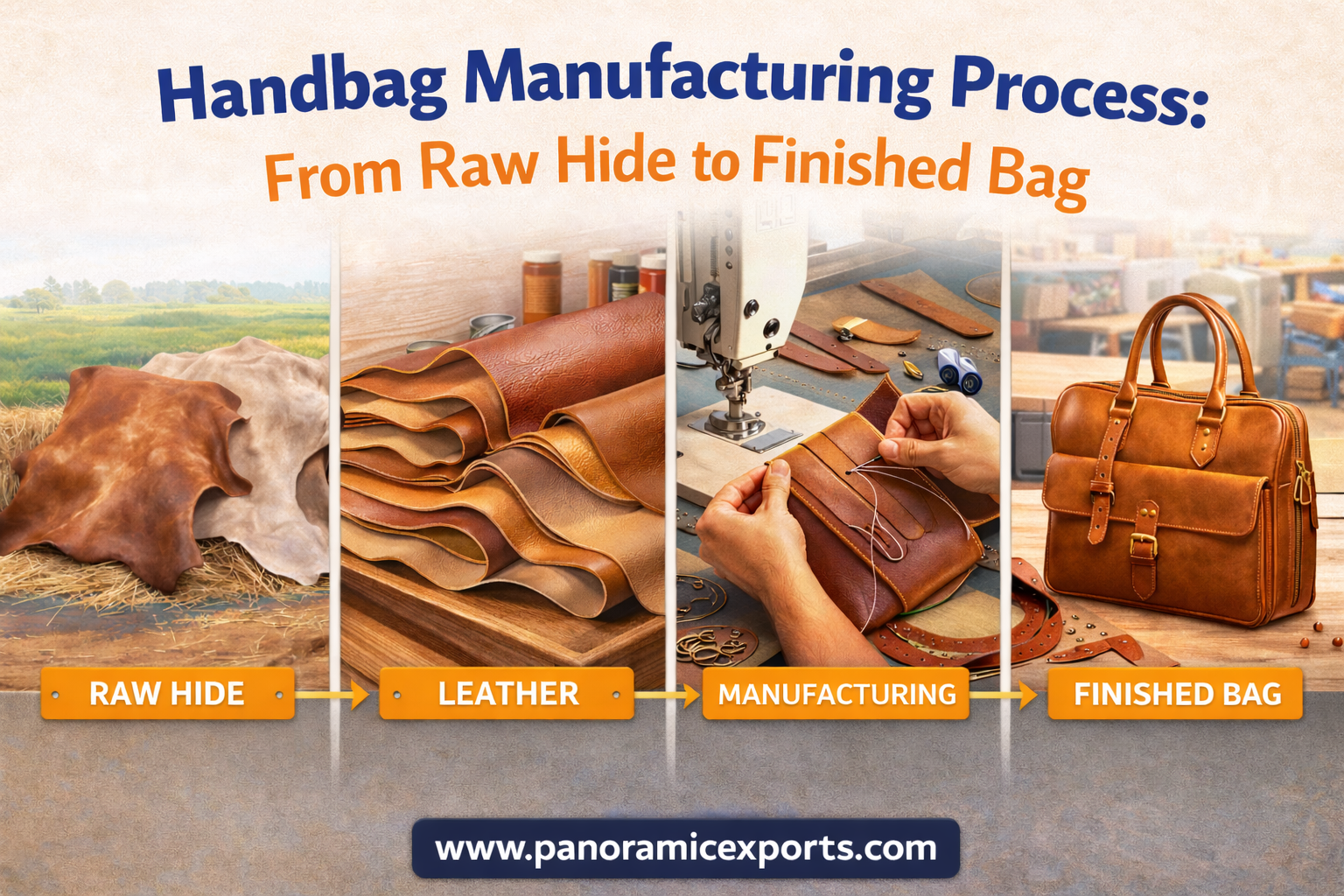
    A good leather bag production process will make the end product not just a fashion accessory; but a masterpiece work of an engineering production process. The following is the step-by-step analysis of the handbag manufacturing process of turning a raw hide into a retail luxury product.


    Step 1: Material Sourcing and Tanning

    The Handbag Manufacturing Process starts way before the manufacturing floor. It starts at the tannery. The treatment done on raw hides is either Chrome Tanning (soft, colored leather) or Vegetable Tanning (barks of the trees that are used in providing a stiff and eco-friendly finish).

    Grading

    Hides are examined on the basis of yield. Bags of high-end need to be made out of A-Grade leather, which is not much damaged by deep scars or bites.

    Splitting & Sharing

    The leather is cut to a uniform thickness (1.2mm to 2.0mm) so that the bag is not too heavy or too thin.


    Step 2: Prototype Development and Pattern Making

    A Master Pattern is made before mass production. It is a critical step in the production of leather bags because the 2D design is converted into the 3D reality.

    CAD Design

    The digital patterns provide mathematical accuracy of laser cutting.

    Counter Sample

    A hard sample is made to test the hang of the bag, internal volume and the strength of the bag.


    Step 3: Precision Cutting

    After the pattern is accepted the leather is cut. There are two primary processes in the professional Handbag Manufacturing Process:

    Die Cutting

    High-volume accuracy is achieved by high volume and heavy steel knives plus a hydraulic press.

    Laser/Digital Cutting

    This is the best to use when the design results are very complex or when the order is a one-off but the volumes are low since there is no way of making a mistake.


    Step 4: Preparation and Skiving

    Leather is naturally thick. In order to have clean and folded edges without build the edges of the cut panels are skived. The underside of the leather edge is shaved by a special machine to leave it paper thin to enable it to be folded over before being sewn on.


    Step 5: Assembly and Stitching

    This is where the Handbag Manufacturing Process begins. The panels are joined with heavy-duty industrial sewing machines by skilled artisans.

    Reinforcement

    Handle attachments, corners of the base are reinforced with tapes of non-stretch (or bonded nylon).

    Lining

    Linings are sewn in together and may include a drop-in type of construction to have a luxury feel.


    Step 6: Edge Finishing and Hardware

    The distinction between a good bag and a luxury bag is in the fringe.

    Edge Painting

    This is a procedure that involves a number of coats of specialized Italian paint that has been sanded to produce a smooth rubberized medium.

    Fitting of Hardware

    Heavy brass or zinc-alloy zippers, buckles and feet are hand-fitted so that they will not scratch the leather in the process of assembly.


    Advanced Techniques in the Modern Handbag Manufacturing Process

    The way quality is being redefined as we look at the future of leather bag production process in 2026 is by incorporation of technology and sustainability. In addition to the usual cutting and stitching, there are newer sophisticated methods that are necessary to all brands that wish to compete at the high export market.


    1. Structural Reinforcement and Boning

    The Handbag Manufacturing Process currently includes internal reinforcements in order to keep the shape of an expensive bag over the decades of usage. That incorporates the application of salpa (re-created leather) or special synthetic stabilizers between the leather and the lining. These make the leather not to drop down and have a light bag. This is also referred to as building the skeleton of the bag in circles of professional leather bag production processes.


    2. Sustainable Adhesive Technology

    The environmental standards have no longer been limited to the leather. The current process protocols used in the handbag manufacturing process have adopted water-based and environment-friendly glues instead of the use of the solvent-based glues. These glues are less harmful to the workers at the factory and the product made can be used free of the body smelling chemicals that most of the cheap imports are known to have.


    3. Precision Heat Creasing

    Heat creasing is one of the characteristics of a really luxurious process of leather bags production. This can be done by pressing a fine decorative line along the edges of the leather, towards the stitching with the use of a metal tool that may be hot or cold. This is not merely the visual pop, it actually tightens the fibers of the leather, which make its edges more resistant and less prone to fraying.


    Global Logistics: The Final Stage of Production

    The Handbag Manufacturing Process does not really conclude until the product is packed up safely. Stuffing is a very important sub-step as far as international export is concerned. To preserve the shape of the bag, one should use acid-free tissue paper or air-filled pillows so that the bag can withstand the 30 days trip by sea between India and the USA or Europe. Moreover, anti-mold stickers (Micro-Pak) have become an obligatory condition of the process of leather bag production to resist the humidity changes during the transit.

    With such granular details, buyers can be able to gauge more well the true value of their inventory. These invisible steps will never be missed at Panoramic Exports and your investment is not wasted at the factory to the retail shelf.


    Panoramic Exports: Mastering the Production Lifecycle

    The Handbag Manufacturing Process in India would not be easy without an on-ground partner that would be aware of the technicalities of every stage. Panoramic Exports is your technical ears and eyes so that your production run do not go off course.

    We will contribute value to your process of producing leather bags by:

    1. Tannery Audits

    We get our supply of tannery material at LWG certified tanneries at Kanpur and Chennai so that the raw material is already compliant with the requirements of the REACH.

    2. Technical Supervision: On-site

    Our team has supervision of the work on the “skiving” and the “stitching” stages to avoid the usual problems related to the process such as the puckering problem and the problem of erratic seams.

    3. Timeline Management

    We remove the delays that are characteristic of offshore manufacturing by tracking every step, i.e. cutting, to the final packing.


    Conclusion

    The Handbag Manufacturing Process is a labor of love that requires a symphony of different skills. From the chemical science of tanning to the manual dexterity of edge painting, every step in the leather bag production process must be executed with the end consumer in mind. For global brands, partnering with a expert like Panoramic Exports ensures that this complex journey results in a product that is beautiful, durable and ethically produced.


    FAQs

    1. How long does the typical Handbag Manufacturing Process take?

    A standard production cycle for an export order is 60 to 90 days, including material sourcing.

    2. Why is “skiving” so important in leather bag production?

    Without skiving, the seams where multiple layers of leather meet would be too thick to sew and would look bulky and unprofessional.

    3. Can a leather bag production process be fully automated?

    While cutting can be automated, high-quality stitching and edge finishing still require the skilled hands of an artisan.

    4. What is the most common cause of failure in the handbag manufacturing process?

    Most failures occur during the “material preparation” stage, where incorrect leather thickness leads to structural weakness.

    5. How does Panoramic Exports ensure the lining doesn’t tear?

    We specify high-denier fabrics and ensure all internal seams are double-stitched and “taped” for maximum durability.

  • How Retailers Choose the Right Handbag Supplier

    How Retailers Choose the Right Handbag Supplier

    How Retailers Choose the Right Handbag Supplier

    The issue of identifying the appropriate Handbag Supplier for Retailers is among the key considerations that fashion enterprises must make in order to grow sustainably and profitably. No matter whether you have a boutique, an online store of fashion, or a big retail chain, the quality of your products, pricing, brand image and customer satisfaction depend on your supplier directly. This is a detailed guide on how to assess, compare and conclude with a handbag manufacturer in wholesale and reduce risks and maximize the future value.


    Strategic Significance of Supplier Alignment

    Retailers need not only a vendor but a partner to conduct operations with over time, a reliable Handbag Supplier for Retailers. The choice of supplier determines the inventory movement, seasonal launching, customer loyalty and profitability. The retailers which have the right fit with the manufacturing partner form a more stable supply chain and foreseeable growth.

    In cases of low supplier alignment, retailers can undergo inconsistency in craftsmanship, delayed deliveries, fluctuating prices or lack of scalability. These problems affect the business and destroy brand reputation.

    Collaborating with a reliable handbag supplier for retailers is a sure way of:

    • Stable production planning

    • Regular quality of craftsmanship

    • Wholesale prices that are competitive

    • Scalable support of manufacturing

    • Stability of long term retail growth


    Step 1: Retail Positioning

    When you are approaching any Handbag Supplier for Retailers, clearly state your brand positioning:

    • Do you aim at the luxury, middle, or low-cost consumers?

    • Are you interested in leather or vegan leather or sustainable materials?

    • Is it trend-driven or timeless designs that you are selling?

    By comprehending their niche, retailers will be able to shortlist a wholesale producer of handbags that would meet their audience expectation.

    When you have sustainability as a brand identity, make sure that your handbag supplier for retailers is accountable in terms of sourcing responsibly and meeting material traceability regulations.


    Step 2: Assess Quality Standards of Products

    Customer retention is determined by the quality of the product. A Handbag Supplier for Retailers should supply:

    • Material samples

    • Consistency of stitching and finishing

    • Hardware durability

    • Color fastness reporting

    • Load-bearing strength tests

    In case of bulk production, retailers must always check samples before facilitating the confirmation. To learn more about the leather grading and responsible sourcing, retailers can use the information about the Leather Working Group guidelines. This will aid in checking the compliance of the handbag supplier for retailers to the international standards.


    Step 3: Evaluate the Capacity to Manufacture

    Before accepting a Handbag Supplier for Retailers, they have to ensure that the latter will have the capacity to meet their orders. Important areas include:

    • Monthly production volume

    • Workforce specialization

    • Machinery infrastructure

    • Lead time accuracy

    • Peak season scalability

    In case your sales grow rapidly, the manufacturer of your handbags on wholesale needs to retain quality and produce more.


    Step 4: Pricing Transparency and Structure of MOQ

    Retail sustainability is based on profit margins. In checking a Handbag Supplier for Retailers, demand:

    • Detailed cost sheets

    • Clarity of Minimum Order Quantity (MOQ)

    • Payment structure

    • Sampling policies

    • Shipping cost estimates

    A wholesale manufacturer of handbags is a professional who has no hidden variables to their pricing.

    Never choose a handbag supplier for retailers simply because they are cheap because this can compromise the quality of its materials or even morality.


    Step 5: Certification and Compliance Check

    There should be strict compliance with regulations in the international retail markets. A compliant handbag supplier to the retailers must offer:

    • EU markets compliance with REACH

    • CPSIA report on imports in the US

    • Certifications of social audit

    • Export administration services

    Companies that import retailers of handbags worldwide need to make sure that their wholesale handbag company is familiar with labeling, customs documentation and testing regulations. Retailers can also review international trade regulations and market access requirements through the International Trade Centre (ITC) guidelines.

    A resolute handbag supplier in retailers reduces legal and logistical hazards.


    Step 6: Communication Infrastructure and Responsiveness

    Effective communication does not cause havoc to operations. The supplier of professional handbags to the retailers must provide:

    • Dedicated account managers

    • Regular production updates

    • Open milestone reporting

    • Fast issue resolution

    The retailers enjoy the systematic communication network which minimizes misconceptions and delays in production.

    A well structured wholesale manufacturing company of handbags greatly enhances the efficiency of the supply chain.


    Step 7: Customization and Private Label Capabilities

    Retail competitiveness is a result of brand differentiation. An efficient Handbag Supplier for Retailers should be able to offer:

    • Custom logo embossing

    • Private label services

    • Proprietary design development

    • Customized packaging services

    • Individualized material and color

    The retailer who would like brand exclusivity should make sure that the wholesale handbag company protects intellectual property.

    A retailer-friendly handbag supply provider helps to launch the brand in the long term.


    Step 8: Logistics Co-ordination and Export Management

    The reliability of shipping is pivotal in product launching that is seasonal. A reliable handbag vendor to retailers must control:

    • FOB and CIF shipping models

    • Freight coordination

    • Packaging optimization

    • Shipment tracking systems

    • Multi-product order consolidation

    The retailer that operates globally must ensure that his wholesale handbag producer knows the export compliance procedures.

    Effective logistics done by your handbag supplier for retailers makes sure there is no disruption in your inventory.


    Risk Avoidance and Due Diligence Model

    The retailers should implement a systematic risk evaluation prior to the closure of a Handbag Supplier for Retailers. The main steps of due diligence are:

    • Conducting factory audits

    • Checking compliance documents

    • Testing production samples

    • Checking the history of exports in the past

    • Authentication of financial stability

    Inability to practice due diligence normally results in expensive disruptions.

    By using systematic verification criteria in the process of identifying a supplier of handbags to the retailers, the retailers save a great deal of operational risk and form more durable supply chain alliances.


    Panoramic Sourcing: Why the Retailers Work with Them

    In Panoramic Sourcing, we assist companies to find the appropriate supplier of handbags to retailers, by means of approved sourcing systems and organized supplier analysis.

    Our services include:

    • Wholesale handbag manufactures networks that have been pre-screened

    • Factory audit verification

    • Production monitoring

    • Quality inspections

    • Open-minded cost negotiation

    We make sure that all handbag manufacturers of retailers in our network achieve quality, compliance and scalability requirements.

    Retailers that collaborate with us will feel secure about the choice of their wholesale handbag supplier for retailers and will minimize the sourcing risks.


    Conclusion

    The process of choosing the appropriate Handbag Supplier for Retailers takes a structured analysis, tactical planning and detailed conformity. Reliability of suppliers, transparency of prices and consistency of goods are important factors that define the success of retailers.

    Retailers that take time to check their wholesale handbag manufacturer develop better brands and have sustainable growth.

    With the implementation of due diligence models and alignment with a reputable handbag retailer in case of retailers, companies have the chance to be profitable in the long run and remain stable.


    FAQs

    1. What are the methods used by retailers to check the Handbag Supplier for Retailers and place bulk orders?
    The retailers must carry out auditing, take samples and check the compliance records.

    2. So what is the optimal MOQ of a wholesaler of handbags?
    MOQ is reliant on product complexity, but flexible quantities help to decrease initial risk.

    3. What is the reason as to why compliance is important to international retail imports?
    Conformity would facilitate clearance of customs and evade legal sanctions.

    4. Is it possible to have retailers to create distinctive handbag designs with manufacturers?
    There are a lot of manufacturers, who provide services of customization and their own label.

    5. How long does handbag production usually take?
    Standard timelines range between 30 to 60 days depending on order volume.

  • Leather Bag Quality Inspection Process for Export

    Leather Bag Quality Inspection Process for Export

    Leather Bag Quality Inspection Process for Export

    The competitive global market is not to be conquered by high-quality materials alone; it must be supported by a strict Leather Bag Quality Inspection system. For exporters to the USA, UK, EU, Canada and Australia, product approval depends on durability, safety, craftsmanship precision and compliance documentation. A small mistake—like loose stitching, uneven edge paint, or restricted chemical content—can result in rejected shipments, refunds, or long-term brand damage.

    By 2026, global buyers will require manufacturers to move beyond basic visual inspections and adopt a structured leather bag QC checklist that includes raw material inspection, workmanship monitoring, functionality testing, compliance validation and packaging integrity checks. A professional leather bag quality inspection system ensures that every bag shipped is uniform, compliant and export-approved.


    The Ultimate Leather Bag QC Checklist: A Step-By-Step Guide

    A systematic Leather Bag Quality Inspection process is divided into structured operational stages. A standardized leather bag QC checklist enables exporters to detect defects early, reduce production loss and maintain consistency in high-volume shipments.


    1. Pre-Production Inspection (PPI)

    This process begins with raw material verification and sample approval before bulk manufacturing starts.

    Key PPI Checkpoints:

    • Leather Grading & Thickness
      Inspectors measure thickness in millimeters, verify grain consistency and match color to approved “Golden Samples.” Natural scars, insect bites, or deep wrinkles must remain within acceptable tolerance limits.
    • Moisture Content Testing
      Leather must maintain balanced moisture levels to prevent cracking or mold formation during sea transport.
    • Hardware Resilience
      Zippers, buckles, rivets and D-rings must be non-ferrous and corrosion-resistant. Salt spray testing verifies rust resistance.
    • Lining & Adhesives
      Inspect bonding strength and confirm adhesives meet international safety standards.

    At this stage of leather bag quality inspection, expensive production rework is minimized and technical clarity is ensured between buyer and manufacturer.


    2. Inline Inspection (DUPRO)

    During production, Leather Bag Quality Inspection shifts to assembly-line monitoring of craftsmanship. Inline inspection prevents cumulative defect build-up across entire batches.

    Workmanship Control Areas:

    • Stitch Density Standardization
      Maintain 7–9 stitches per inch (SPI) to ensure seam strength and aesthetic balance.
    • Panel Alignment & Symmetry
      Pockets, zippers, handles and logos must align precisely to avoid structural imbalance.
    • Edge Paint Consistency
      Inspect smoothness and uniform coating without cracks or uneven application.

    Inspectors use a structured leather bag QC checklist to record defects in real time, allowing immediate corrective action.


    3. Final Random Inspection (FRI)

    Final Random Inspection is the most critical stage of Leather Bag Quality Inspection before shipment.

    When production is 100% complete and at least 80% packed, inspectors apply the AQL (Acceptance Quality Limit) sampling method.

    Final Audit Includes:

    • Visual & Surface Review
      Examine scratches, stains, loose threads and surface inconsistencies.
    • Functional Testing
      Zippers must complete 20+ pull cycles. Magnetic snaps and buckles must operate smoothly without stiffness.
    • Load Stress Test
      The bag is filled to its maximum rated capacity and suspended for 4 hours to test seam strength and handle durability.
    • Rub & Smell Test
      A rub test checks for dye transfer, while a smell test detects chemical over-treatment or mold contamination.

    All checkpoints are documented in the leather bag QC checklist to provide objective shipment approval data.


    2026 Global Standards and Compliance

    Modern leather bag quality inspection cannot be separated from regulatory compliance.

    Chemical Safety (REACH & CPSIA)

    Export leather bags must comply with:

    • Chromium VI limit (≤ 3mg/kg)

    • Lead content restrictions

    • Prohibited azo dyes

    • Phthalate limitations

    Exporters may consult the European Chemicals Agency (ECHA) to understand REACH obligations and restricted substance limits:

    Compliance verification during leather bag quality inspection prevents customs delays and penalties.


    Packaging and Transit Protection

    Leather Bag Quality Inspection must include packaging integrity for sea and air shipments.

    Inspectors verify:

    • Five-ply or seven-ply export cartons

    • Silica gel moisture absorbers

    • Proper dust bag quality

    • Barcode accuracy

    • Carton drop resistance

    Poor packaging can damage premium leather during transit, leading to retailer complaints and returns.


    Defects in Leather Bag Quality Inspection

    Professional reports classify defects as:

    • Critical Defects
      Hazardous flaws such as sharp edges, needle fragments in lining, or chemical non-compliance.
    • Major Defects
      Structural issues like broken zippers, uneven stitching, or seam slippage.
    • Minor Defects
      Cosmetic imperfections such as slight color variation or minor surface wrinkles.

    Inspectors use a structured leather bag QC checklist to assign defect levels based on AQL standards and determine pass or fail status.


    Documentation and Reporting Structure

    A professional quality inspection report includes:

    • Factory name and inspection location

    • Total production quantity

    • AQL sampling size

    • Defect classification summary

    • Photographic evidence

    • Corrective action notes

    • Final shipment recommendation

    Buyers require transparent documentation before releasing final payments.

    A well-designed leather bag QC checklist ensures traceable accountability and builds buyer confidence.


    Why Leather Bag Quality Inspection Determines Export Success

    Exporters who do not implement a professional bag quality inspection system face higher risks of:

    • Container rejection

    • Financial penalties

    • Marketplace suspension

    • Increased returns

    • Brand reputation loss

    By adopting a detailed leather bag QC checklist, manufacturers align Indian craftsmanship with global performance standards.

    Quality consistency is not accidental; it is structured and measurable.


    Panoramic Exports: Your On-Ground Quality Assurance Partner

    At Panoramic Exports, we treat Leather Bag Quality Inspection as a strategic safeguard, not a procedural formality. We combine international buyer specifications with real-time factory supervision.

    Each leather bag QC checklist is customized according to:

    • Market-specific regulations

    • Retailer brand standards

    • Private label requirements

    • Packaging expectations

    • Shipment timelines

    Within 24 hours of inspection, clients receive a detailed report with high-resolution images and AQL evaluation results.

    From handcrafted clutches to large-scale office messenger shipments, our quality inspection system ensures global compliance and brand protection.


    Conclusion

    A structured Leather Bag Quality Inspection process is the foundation of a reliable export business. From raw leather verification to final packaging audits, every stage contributes to shipment integrity and customer satisfaction.

    By following a comprehensive leather bag QC checklist and staying updated on global compliance standards, exporters can confidently meet international expectations in 2026 and beyond.

    Quality is not a one-time action. It is a disciplined system that begins with material selection and ends with consumer trust.


    FAQs

    1. What is a “Critical Defect” in leather bag inspection?
    A: It is any flaw that makes the product unsafe or non-compliant, such as sharp metal burrs or chemical violations.

    2. How many stitches per inch should export-grade bags maintain?
    High-quality export bags typically require 7–9 stitches per inch for durability.

    3. Why is the rub test essential in Leather Bag Quality Inspection?
    It ensures that dye does not transfer onto clothing during normal use.

    4. What AQL level is common for leather exports?
    Many buyers accept AQL 2.5 for major defects and 4.0 for minor defects.

    5. Can brands customize their own leather bag QC checklist?
    Yes, sourcing partners can tailor inspection checkpoints to match specific brand standards.