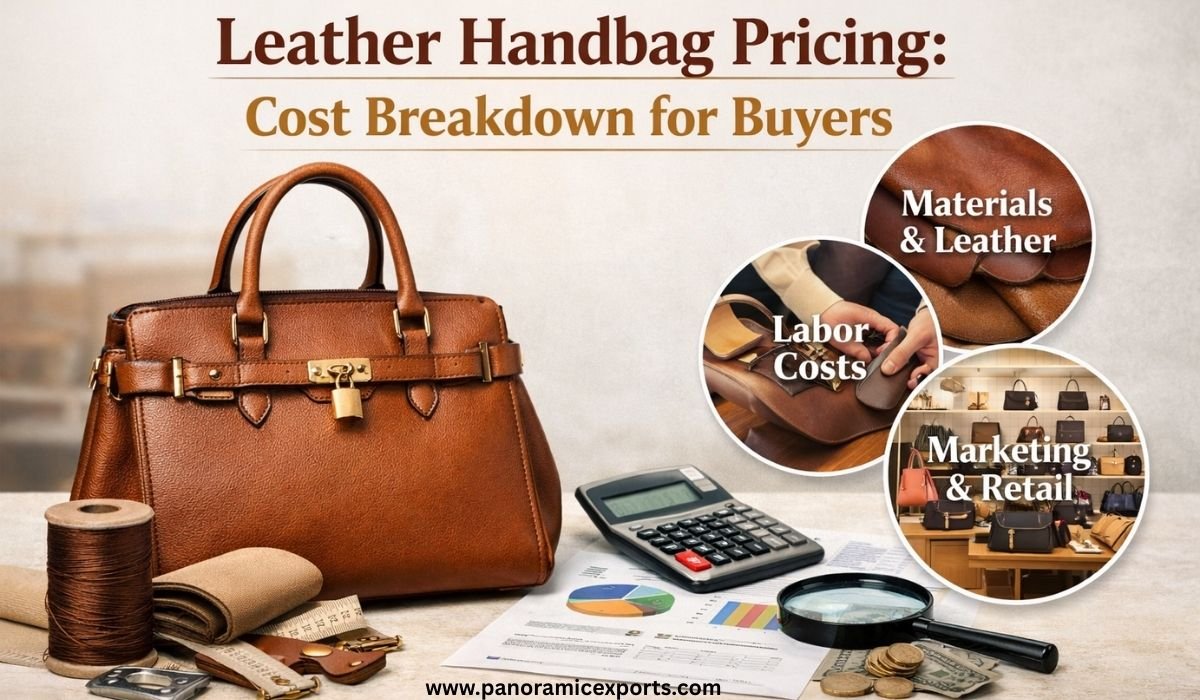
Leather Handbag Pricing: Cost Breakdown for Buyers
If you have ever looked at two factory quotes and wondered why one bag is $25 and the other—which looks exactly the same—is $65, you aren’t alone. In the export business, a price isn’t just a random number someone pulled out of thin air; it is a carefully built formula. Understanding the Leather Handbag Pricing Factors is the only way a buyer can actually negotiate without accidentally killing the quality of their own product.
At Panoramic Exports, we don’t believe in “black box” pricing. We think transparency is the only way to build a real partnership. When you see exactly where every dollar is going, you can make actual decisions about where to spend your budget and where to trim the fat. Here is the real, unpolished look at how we calculate the value of a high-end leather accessory.
1. The Raw Material: It’s All About the Yield
The biggest of all Leather Handbag Pricing Factors is the skin. But here is what most beginners miss: it isn’t just about the price per square foot. It’s about “Yield.”
Leather is a natural product, not a roll of fabric. It has scars, bug bites and thin patches. If you want a “Grade A” bag with big, clean panels, the wastage is huge. We might have to buy 20 square feet of expensive leather just to get 10 square feet of “clean” cuttings for your bag.
-
Full-Grain vs. Top-Grain: This choice alone shifts the price by 30% instantly.
-
The Tanning Process: Chrome-free or Vegetable-tanned leathers cost more because they take longer and use pricier chemicals.
-
The Animal: Buffalo, Goat and Cow hides all have different price points based on how tough they are and how “luxurious” they feel to the touch.
2. The Skeleton: What You Can’t See
When buyers argue over leather handbag pricing factors, they usually ignore the stuff inside. A bag that keeps its shape for five years is built differently than a cheap one that collapses after two months.
-
Reinforcements: We use different grades of interlinings—things like salpa, non-woven stiffeners, or foam—to give the bag its “skeleton.”
-
Linings: A cheap polyester lining costs almost nothing, but a premium cotton twill or real suede lining changes the whole vibe—and the price.
-
Glues: We use high-quality, eco-friendly adhesives that don’t peel or smell when it gets humid. That’s a hidden but vital cost.
3. Hardware: The Jewelry of the Bag
Hardware is one of the most volatile Leather Handbag Pricing Factors. It isn’t just about the weight; it’s about the “Plating.”
-
Zinc vs. Brass: Solid brass hardware is expensive and heavy. Zinc alloy is the budget-friendly alternative.
-
The Finish: Is it a quick dip, or is it “Electrophoretic” plating that actually resists scratches and tarnishing?
-
The Zippers: Putting a YKK or Excella zipper on a bag can add $3 to $7 to the cost compared to a generic local brand. But it’s the difference between a bag that lasts and a bag that breaks in a week.
4. Labor and the “Minute Cost”
We don’t guess labor costs. We use the leather handbag pricing factors based on “Standard Allowed Minutes” (SAM). Every single movement—skiving the edges, painting the leather, stitching the gusset—is timed to the second.
-
Edge Painting: A “raw edge” is the cheapest. A “folded edge” is middle-of-the-road. A “hand-painted edge” that needs four coats of ink and sanding between each coat? That is a high-cost labor item.
-
Pattern Complexity: A bag with 50 different pattern pieces takes three times as long to stitch as a 5-piece tote. This complexity is a massive driver in Leather Handbag Pricing Factors.
5. The Export Reality: Overhead and Logistics
When we give you an FOB (Free On Board) price, we have to include the “Export Overhead.”
-
Compliance: If your country needs REACH or California Prop 65 testing, we have to factor in those lab fees.
-
Packaging: Does the bag go in a polybag, or a branded dust bag inside a rigid gift box? A high-end box can add $5 to the price before the bag even leaves the factory. Many international buyers also expect packaging and production quality systems aligned with global benchmarks such as those defined by the International Organization for Standardization (ISO).
-
Inland Freight: Moving goods from our workshop in Noida to the port (like Nhava Sheva) is a fixed piece of our leather handbag pricing factors.
Why Panoramic Exports Gives You Better Value
We aren’t trying to be the “cheapest” factory in India. We want to be the most “efficient.” There is a massive difference. At Panoramic Exports, we control the Leather Handbag Pricing Factors by keeping our supply chain tight.
How We Handle Your Money:
-
Direct Sourcing: We buy hides directly from LWG-certified tanneries. No middleman, no extra markup.
-
In-House Finishing: We do our own edge-painting and hardware fitting. It keeps quality high and the leather handbag pricing factors honest.
-
Yield Transparency: We show our clients exactly how much leather we are using. If we can tweak a pattern to save you 10% on leather wastage, we’ll tell you.
When you work with us, you are buying a transparent process. Every cent is visible.
The “Hidden” Variable: Production Waste and Rejection Rates
One thing that never shows up on a clean spreadsheet but absolutely dictates Leather Handbag Pricing Factors is the rejection rate. In a high-end export house, we don’t just stitch and ship. We inspect at every stage. If a craftsman spends four hours on a bag and then finds a natural vein pop in the leather on the final gusset, that bag is pulled.
This “cost of quality” is built into your price. A cheaper factory will just stitch over the flaw and hope your QC team doesn’t catch it at the port. We factor in a buffer for material wastage and “seconds” because we’d rather eat the cost of a mistake here in Noida than have you deal with a return in London or New York. When you look at a leather handbag pricing factors, you have to ask yourself: am I paying for a 100% pass rate, or am I gambling on a 20% defect rate? In the long run, paying for the “perfection buffer” is the only way to scale a brand without losing your mind to customer complaints.
Conclusion
The “perfect” price is just a balance between what your customers will pay and the physical cost of the materials. By understanding these Leather Handbag Pricing Factors, you can choose where to go for luxury and where to save your margin. Whether it is a high-volume shopper or a tiny luxury clutch, the math doesn’t lie.
Value isn’t the lowest price—it’s the best quality you can get for the money you spend. At Panoramic Exports, we help you find that balance every time.
FAQ: Costing Clarity
1. Why is white leather more expensive?
White or pastel hides have to be nearly perfect because you can’t hide scars or marks as easily as you can with black leather.
2. Do big orders change the Leather Handbag Pricing Factors?
Yes. Large orders let us spread the cost of die-cutting and pattern-making over more units, which drops the per-piece price.
3. How do Leather Handbag Pricing Factors work for custom designs?
New designs need custom metal molds for hardware and cutting dies. These are usually one-time “start-up” costs.
4. What is the single most expensive part of a bag?
Usually, it’s a tie between the leather “Yield” and the total labor hours spent on hand-finishing the edges.
5. Can I save money by sending my own hardware?
Definitely. We have many clients who ship their branded hardware to us and we simply subtract that from the leather bag costing breakdown.