Category: Fashion Bags

  • Vintage Beaded Bags for Retailers in USA, UK, Canada & Australia

    Vintage Beaded Bags for Retailers in USA, UK, Canada & Australia

    Vintage Beaded Bags for Retailers in USA, UK, Canada & Australia

    Consumers in New York, London and Sydney are exhausted. They are tired of the “plastic-perfect” look of fast fashion. They are hunting for items that feel like they were pulled from a 1920s cedar chest but can actually hold a modern smartphone without the seams bursting. For a boutique owner or a heritage brand manager, sourcing Vintage Beaded Bags is the only way to capture this “Heirloom Economy” where the story of the product is just as valuable as the SKU itself.

    At Panoramic Exports, we’ve spent two and a half decades bridging the gap between historical artistry and the brutal reality of modern export standards. We don’t just “copy” old designs; we re-engineer them from the thread up. Whether you are looking for a retro beaded handbag that channels the jazz age or a heavy, structured 1920s style beaded purse, you need a partner who understands the “Grime and the Grace” of the manufacturing process.


    The Heritage Wave: Why “Old” is the New Gold

    The global fashion cycle has officially moved into a “Period-Piece” phase. We are seeing a massive resurgence of the “Grand millennial” aesthetic across the UK and USA. This isn’t just a trend; it’s a rebellion. Stocking Vintage Beaded Bags allows a retailer to offer a conversation piece.

    Channeling the “Great Gatsby” Aesthetic

    If you are catering to the event and bridal market in Australia or Canada, the demand for a Great Gatsby bag has never been higher. This specific style requires a mix of fringe work, Art Deco geometry and high-shine glass beads. The challenge for most bags manufacturers is the “structural sag”. We use a double-stitch reinforcement at the frame hinges to solve this exact “modern-meets-vintage” problem.

    The Return of the Classic Evening Bag

    While streetwear dominated the early 2020s, 2026 is the year of formal elegance. The classic evening bag is back, but with a twist. Buyers want the look of a 1940s frame bag but with the security of a magnetic “silent” closure and a reinforced shoulder chain.


    The Manufacturing Reality: Re-Creating the 1920s in 2026

    To manufacture Vintage Beaded Bags that actually sell, you have to understand the “invisible” architecture. The way an artisan in 1925 secured a bead is different from how a modern machine does it.

    The Aari and Zardosi Techniques

    In our North Indian facilities, we utilize traditional Aari (hook) work to create the intricate floral patterns found in vintage beaded bags. This isn’t a process you can automate. It requires a human eye to ensure the tension of the thread doesn’t warp the backing silk. If you are sourcing an heirloom style handbag, you need to ensure the base fabric is “pre-shrunk” and reinforced.

    Frame Integrity and Salt-Air Corrosion

    One of the biggest “pain points” for retailers in Sydney or Vancouver is hardware tarnish. Because vintage bags often use brass or “antique gold” finishes, they are magnets for salt-air corrosion during the 45-day sea transit. At Panoramic Exports, we treat all our frames with a 2026-standard anti-oxidation coating.


    Navigating the 2026 Supply Chain Chaos

    Shipping delicate vintage beaded bags from India to the USA or Canada in 2026 is a logistical minefield. Between the Suez Canal “humidity traps” and the ever-shifting freight rates, you need a partner who understands the grit of the journey.

    The “Crush” Factor in Packing

    You cannot simply toss Vintage Beaded Bags into a master carton. The beads will rub, causing “glass-on-glass” friction that ruins the finish. We use a multi-layer packing system: acid-free tissue to prevent pH migration, a breathable non-woven dust bag and individual structural boxes.

    Compliance: The 2026 PPWR Audit Trail

    If you are a retailer in the UK or Australia, the Packaging and Packaging Waste Regulation (PPWR) is your new reality. Your vintage beaded bags must arrive in packaging that is 100% recyclable and plastic-free. We’ve already transitioned our supply chain to use molded pulp and FSC-certified cardboard, ensuring that your heritage collection clears customs without a single “sustainability fine” or delay.


    Why Panoramic Exports is Your On-Ground Muscle

    You can’t manage a Vintage Beaded Bags production run from a laptop in London. You need eyes on the factory floor in Noida or Kolkata. We act as your strategic bridge, handling the quality control and raw material testing that middlemen usually ignore.

    In-Line QC vs. Final Inspection

    Most vendors wait until the bags are finished to check them. We don’t. For our beaded bags, we perform “In-Line” checks on day five. If a pattern is a millimeter off, we catch it then. This proactive approach is the reason our return rate from USA boutiques is among the lowest in the industry.

    Customization for Private Labels

    We aren’t just a wholesaler; we are a design house. If you want to create a retro beaded handbag with your brand’s unique logo on the inner lining, or a specific bead color that matches your 2026 Autumn palette, we can do it. We help you choose the right bead weights and “hand-feel” to ensure your private label stands for quality and authenticity.


    The 2026 Trend Forecast: What’s Actually Moving?

    If you are stocking up for the next two quarters, our data shows three major shifts in the Vintage Beaded Bags market.

    1. The “Nature-Core” Vintage

    We are seeing a move away from “shiny and plastic” toward earthy, matte beads. Think sage green and burnt terracotta integrated into a vintage beaded bags silhouette. It’s the fusion of the “Boho” look with “1920s Structure”.

    2. The Oversized “Day-to-Night” Retro

    The tiny “coin purse” look is being replaced by larger vintage bags that can actually hold a tablet or a large makeup kit. It’s about functional glamour for the 2026 professional.

    3. The Metal-Mesh Fusion

    Combining traditional beading with metal-mesh is a huge hit for the 2026 evening wear market in the USA and Canada. It provides a “liquid” movement that machines can’t replicate.


    Conclusion

    The gap between a “good” vintage bag and a “cheap” knock-off is the attention paid to the “invisible” details. When you invest in Vintage Beaded Bags from Panoramic Exports, you are buying 25 years of manufacturing heritage. We handle the grit, the needles, the compliance and the containers so you can focus on your storefront. Let’s build your next collection in the heart of India’s artisan clusters.


    FAQs

    1. What is the minimum order for Vintage Beaded Bags?

    We typically start at 50 units per design. This ensures artisanal quality control and consistent hand-beading across the batch.

    2. How do you handle shipping to Amazon FBA in the USA?

    We offer full DDP shipping and FNSKU labeling at our facility, so your goods arrive retail-ready at the warehouse.

    3 Are the beads on your vintage style bags lead-free?

    Absolutely. All our beaded bags are made using REACH and Proposition 65 compliant materials for total safety.

    4. Can I get a custom sample before bulk production?

    Yes. We provide physical prototypes in 10-15 days so you can test the “hand-feel” and frame tension yourself.

    5. How do you prevent mold during long-haul sea freight?

    We use industrial-grade, DMF-free silica poles and manage the “dew point” inside the container to prevent moisture damage.
  • How to Source Beaded Tote Bags from India for USA & UK Markets

    How to Source Beaded Tote Bags from India for USA & UK Markets

    How to Source Beaded Tote Bags from India for USA & UK Markets

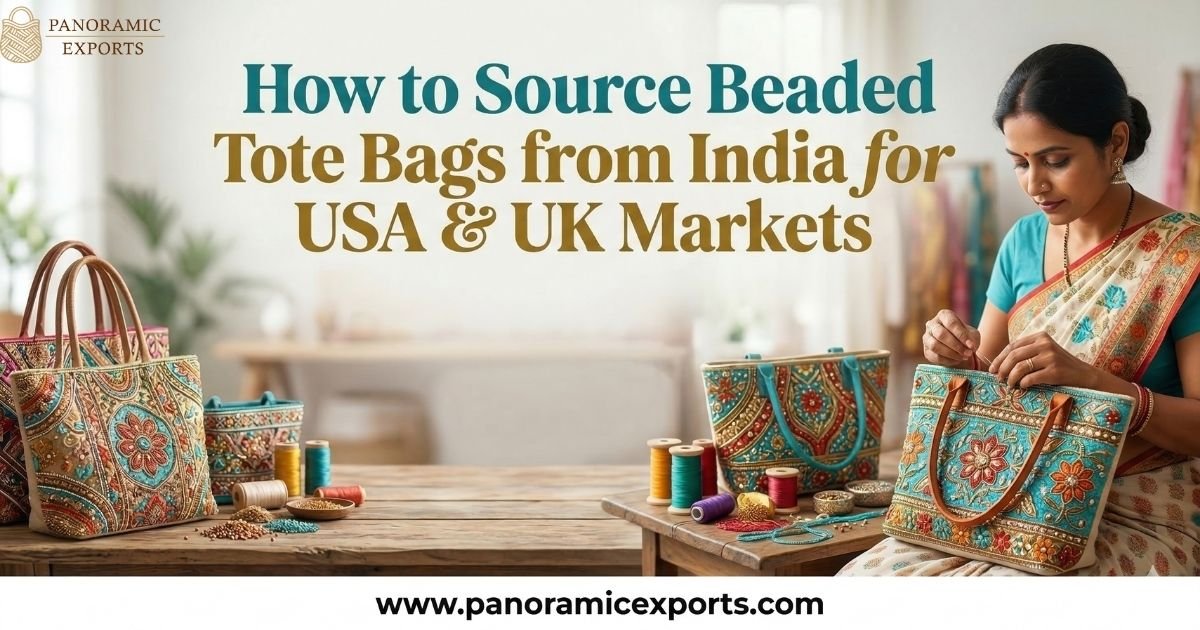
    As per the state of global retail today: the “disposable fashion” era is officially dead. Buyers in New York, London and Manchester are hunting for “Functional Art.” This shift has pushed Beaded Tote Bags from the gift-shop niche straight into the high-fashion mainstream. But here is the reality check: a tote is a load-bearing workhorse. If your supplier treats an embellished bag like a simple clutch, your shipment will be a box of broken glass and failed handles.

    At Panoramic Exports, we’ve spent 25 years in the trenches of the Indian export sector. We’ve seen $50,000 orders of Beaded Tote Bags fail because a vendor used a “fashion stitch” instead of a “utility lock” on the straps. Whether you are building a private label for the USA or you are a UK-based wholesale supplier, you need the technical “Grime and the Grace” of actual manufacturing—not just a glossy catalog.


    The Structural Foundation: Engineering for Durability

    A tote bag has a hard life. It’s shoved into overhead bins, dropped on subway floors and packed with heavy laptops. Most Beaded Tote Bags fail because they are “under-engineered.” We build them differently at our Noida facility to ensure they survive the daily grind.

    • The Anti-Sag Interlining: We use a high-tensile interlining (180 GSM minimum) between the beadwork and the lining. Without this, the weight of the glass beads causes the fabric to “droop” over time, destroying the silhouette.

    • The Multi-Lock Stitch: Standard “Aari” beading is a continuous thread. One snag and the whole bag unravels. We integrate “knot-stops” every 10 centimeters so one loose bead doesn’t kill the entire pattern on your Beaded Tote Bags.

    • Reinforced Handle Anchors: We don’t just stitch handles to the fabric. We use internal cross-stitched “anchors” hidden inside the lining. This is non-negotiable for bead tote bags destined for the high-volume USA market.

    • Hardware Integrity: Every zipper and magnetic clasp is salt-spray tested for 48 hours. This prevents the “pitting” and rust common in bags that sit in humid sea containers for 40 days.


    Logistics: Navigating the “Suez Trap”

    Shipping Beaded Tote Bags is a logistical firefight. Between ongoing canal disruptions and the equator’s humidity, your logistics plan is just as vital as your design.

    • Managing the Dew Point: As containers cross the equator, they “sweat.” This “Container Rain” creates permanent water spots on cotton linings. We use 1kg industrial desiccant poles in every 20ft container to keep the air dry for your tote bags.

    • Packaging Compliance: If you are a UK retailer, you are likely sweating the latest EU/UK PPWR laws. We’ve removed all single-use plastics from our bags packaging. We use molded pulp and FSC-certified tissue—avoiding the “sustainability fines” that eat into your margins.

    • FBA Readiness: For our US-based Amazon sellers, we offer “Ready-to-Ship” packing. Each bag is pre-labeled with FNSKUs and packed in “Frustration-Free” cardboard sleeves, saving you a massive 15% on domestic warehouse prep.


    The Design Shift: What’s Moving Now?

    To win in the modern market, you can’t just follow trends—you have to set them. We are seeing a hard pivot toward “Nature-Core” and tactile luxury.

    • Matte over Metallic: Buyers are moving away from “shiny plastic” beads. The winners are matte glass, wooden seeds and even upcycled bone accents.

    • The “Hybrid” Tote: Full beadwork is heavy. We are seeing a surge in Beaded Tote Bags that feature a “beaded focal point” on a heavy-duty jute or organic canvas base. It’s the visual punch of a luxury bag with the lightweight convenience of a canvas tote.

    • Tonal Embroidery: Tone-on-tone beading (black beads on black fabric) is the current “Quiet Luxury” move for professional bead bags.


    Strategic Quality Control with Panoramic Exports

    We aren’t a middleman; we are your on-ground engineering team. When you partner with Panoramic Exports, you are cutting out the 20% “trading commission” that usually inflates costs, gaining direct access to a team that lives on the factory floor.

    • Scalable Craftsmanship: We manage over 400 artisans in the Delhi-NCR cluster, allowing us to scale production of Beaded Bags from 50 units to 5,000 units without sacrificing that “human-touched” soul.

    • The Day-5 Protocol: We perform “In-Line” inspections on day five of production—not day fifty. By checking bead tension early, we prevent bulk errors before they happen.

    • Load-Bearing Stress Tests: We stress-test strap attachments and weight distribution before the final lining is even sewn. This proactive engineering is why our defect rate for beaded tote bags remains the lowest in the Noida export zone.

    • End-to-End Handling: We manage everything from the first needle-stroke to the final customs paperwork. You focus on building your brand; we handle the grit of the manufacturing process.


    The Human Element: Beyond the Spreadsheet

    When you source beaded tote bags from India, you aren’t just engaging a supply chain; you are supporting a lineage rooted in the long history of decorative beadwork that predates modern industry. In an era of AI-generated everything, this raw, human connection is your strongest selling point. Here is the reality of the hands behind your product:

    • Artisanal Lineage: In our Noida workshop, the air is filled with the rhythmic “clinking” of glass on wood—a sound that has defined Indian craft for generations.

    • The Individual “Signature”: Every one of our Beaded Tote Bags carries the distinct mark of the artisan. You will notice slight variations in thread tension or a unique way of securing a knot that makes it impossible to replicate by a machine.

    • Authenticity Over Perfection: We encourage our buyers to value these subtle “human” differences. It is exactly this raw imperfection that transforms a simple purchase into a valued heirloom for your customers in London or New York.

    • The Ethical Handshake: By seeing the individual hand behind the hook, you move from being a simple importer to a patron of a craft, ensuring these technical skills survive in a world of automation.


    Conclusion

    Success in the global tote market requires a partner who understands that Beaded Tote Bags are technical products, not just fashion accessories. They must survive the grit of global shipping and the grind of daily use. By partnering with Panoramic Exports, you leverage 25 years of Indian manufacturing heritage to ensure your collection arrives retail-ready, every time. Let’s get your next shipment moving.


    FAQs

    1. What is the minimum order for Beaded Tote Bags?

    We typically start at 50 to 100 units per design to maintain the strict quality control required for boutique sourcing.

    2. How long does it take to ship Bags to the UK?

    Production takes 45-60 days. Sea freight takes another 30-35 days, or 7-10 days by air for high-value drops.

    3. Are your materials compliant with US safety standards?

    Yes, we use lead-free glass beads and Azo-free dyes for all Beaded Bags intended for the USA market.

    4. Can you handle custom private-label branding?

    Absolutely. We offer custom inner linings, embossed leather logo tags and FBA-ready packaging for your Bags.

    5. How do you prevent moisture damage during the sea voyage?

    We use industrial-grade, DMF-free silica poles and manage the “dew point” inside the container to ensure your Beaded Bags arrive dry.

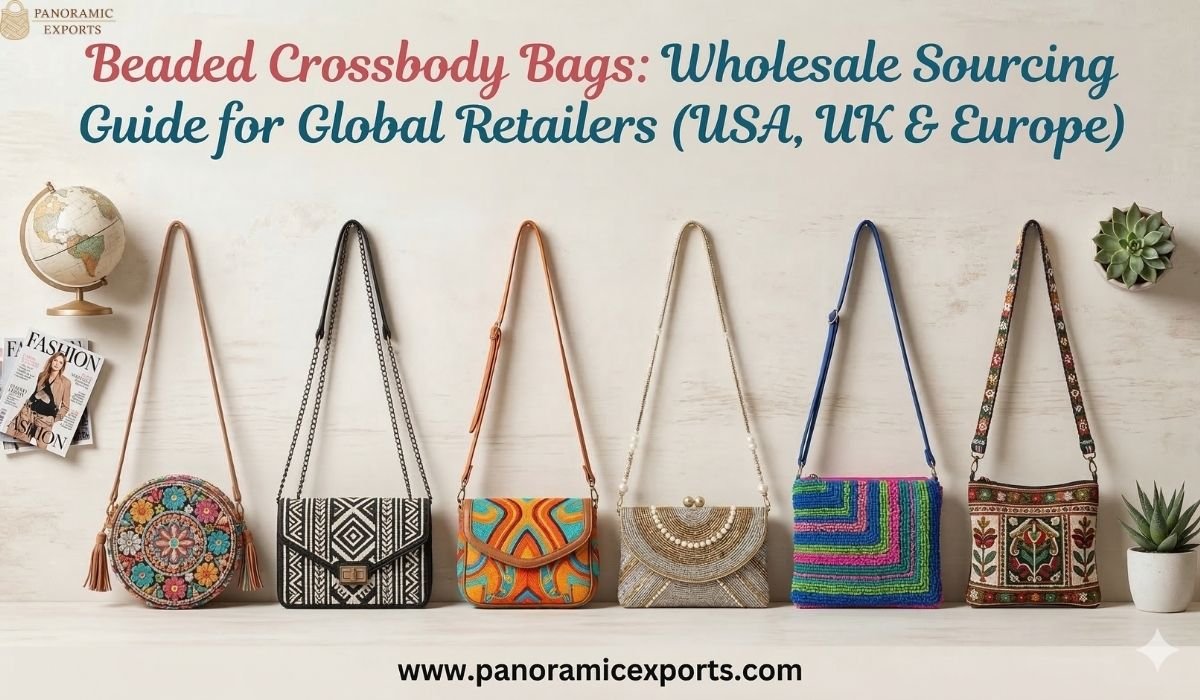
  • Beaded Crossbody Bags: Wholesale Sourcing Guide for Global Retailers (USA, UK & Europe)

    Beaded Crossbody Bags: Wholesale Sourcing Guide for Global Retailers (USA, UK & Europe)

    Beaded Crossbody Bags: Wholesale Sourcing Guide for Global Retailers (USA, UK & Europe)

    Retail in 2026 is no longer about just filling shelves; it’s about defending your brand against “generic fatigue”. For buyers in the USA, UK and Europe, the move toward Beaded Crossbody Bags represents a shift toward accessories that feel personal and irreplaceable. However, the path from an Indian workshop to a London or New York boutique is paved with quality-control risks and compliance hurdles that many generic wholesale handbag suppliers simply don’t mention.

    If you are looking to import handbags from India, you aren’t just looking for a product; you’re looking for a supply chain that won’t break under the weight of Amazon return rates or EU customs audits. This guide breaks down the “on-the-ground” reality of global sourcing handbags in today’s high-stakes fashion climate.


    Why Crossbody Embellishment is Winning

    The current crossbody bags trends show a definitive break from the “minimalist leather” era. Today’s consumer wants texture. We are seeing a massive surge in “Jewelry-as-Bags”—pieces where the beadwork serves as the primary aesthetic. For a retailer, this is a high-margin opportunity because handcrafted beadwork carries a much higher perceived value than machine-stitched synthetics.

    Whether it’s the “undone” bucket bag look or the structured “barrel” silhouette, the integration of glass seed beads, upcycled wood and even semi-precious stones is what separates a premium SKU from a mass-market one. When you export handbags India styles to Western markets, you are selling the “Human Touch” that automation can’t replicate. The demand for Beaded Crossbody Bags has spiked specifically because they offer a hands-free convenience without sacrificing the high-glamour look required for 2026’s “Day-to-Night” lifestyle.


    Navigating the Compliance Landscape for USA & EU Markets

    Let’s talk about the part most vendors ignore: the legalities. Importing Beaded Crossbody Bags into the US or Europe in 2026 involves more than just a commercial invoice. You need to be certain that the materials used won’t get your shipment flagged at the port of entry.

    • The REACH regulation & Prop 65 Reality: It means that if your beads contain lead or your linings use prohibited Azo dyes, your shipment can be stopped at the port.

    • The “Traceability” Mandate: European buyers are now under the “Digital Product Passport” pressure. You need a partner who can provide a transparent paper trail from the bead mill to the final stitch.

    • Customs Duty Awareness: Under the GSP (Generalized Scheme of Preferences), many Indian handmade goods enjoy reduced tariffs, but only if your paperwork is flawless. One wrong HS code (typically 4202 for leather/textile bags) and you’re looking at a 12% duty spike.


    Why the “Panoramic Exports” Model is Different

    Most fashion accessories wholesale firms are middlemen. They buy from a cluster and sell to you. We don’t. At Panoramic Exports, we operate a “Vertical Integration” model. We own the process from the selection of materials to the production floor in Noida. We understand that a Beaded Crossbody Bags order isn’t just about the embroidery; it’s about the “structural architecture”.

    The Logistics of Quality: From Noida to the Warehouse

    Shipping delicate beadwork is a specialized skill. You can’t just toss a thousand Beaded Crossbody Bags into a container and hope for the best.

    1. Humidity Control: Sea freight is a killer for metal-lined beads. We use industrial-grade desiccant silica and airtight primary packaging to prevent tarnish.

    2. The “Crush” Test: We pack using a “Suspended Box” method for our high-end beaded pieces, ensuring no pressure is applied directly to the embellished surface during transit. This is essential for beaded crossbody bags because the weight of the strap can often crush the delicate beadwork if not packed correctly.

    3. Audit Readiness: For our US-based Amazon FBA clients, we apply the FNSKU labels and provide the 10+2 ISF filing data 48 hours before the ship leaves the port.


    Avoiding the “Middleman Markup” in Global Sourcing

    The biggest mistake new retailers make is buying from a “trading company” rather than a direct manufacturer. A trading company adds a 20-30% markup without adding a single ounce of quality control. When you source Beaded Crossbody Bags directly from us, you are cutting out those hidden costs. This allows you to either lower your retail price to be more competitive or enjoy a much healthier profit margin.

    Furthermore, direct communication with the factory means you can make real-time changes to your designs. If you see a specific color trending on social media, we can pivot your production of bead crossbody bags much faster than a middleman could.


    The “Invisible” Details: Lining, Zippers and Reinforcement

    A bag is only as good as its weakest point. For Beaded Crossbody Bags, that point is usually the zipper or the strap attachment. We use YKK-equivalent, rust-resistant zippers and reinforced D-rings that are salt-spray tested. This ensures that even if your customer lives in a humid coastal city, the hardware on their bag won’t tarnish or snap.

    We also focus on “Interlining”. Most cheap crossbody bags feel like cardboard because they use low-grade stiffeners. We use a proprietary blend of foam and textile backing that gives the bag a “memory”—it keeps its shape but feels soft to the touch. This “Hand-Feel” is what convinces a customer in a boutique to take the bag to the register.


    Building a Sustainable Private Label

    The 2026 consumer is looking for a “guilt-free” purchase. When you develop your private label Beaded Crossbody Bags with Panoramic Exports, you can honestly market them as ethically made. We are a SEDEX-audited facility. This means no child labor, no forced overtime and a safe working environment.

    We are also moving toward “Circular Design”. We offer beaded crossbody bags that use recycled linings and lead-free glass beads. By choosing these options, you aren’t just selling a Beads Bag; you’re selling a commitment to the planet.


    Conclusion

    The gap between a “good” sample and a “bad” bulk shipment is usually a lack of on-ground supervision. When you source Beaded Crossbody Bags through a partner like Panoramic Exports, you are buying peace of mind. You focus on the storefront; we handle the grime, the needles, the compliance and the containers. Our goal is to make your sourcing process so seamless that you forget we’re thousands of miles away. Let’s build a collection that survives the audit and wins the customer.


    FAQs

    1. What is the lead time for custom Beaded Crossbody Bags?

    Expect a 60 to 90-day window, as authentic hand-beading is a slow-craft process that cannot be rushed without losing thread tension.

    2. How do you ensure the beadwork doesn’t snag on luxury fabrics?

    We use a specialized “back-tack” stitching technique and smooth-edged glass beads to ensure the bag is safe against silk or cashmere.

    3. What are the MOQ requirements for European boutiques?

    We offer flexible MOQs starting at 50 units per style to help smaller brands scale without heavy inventory risk.

    4. Are your manufacturing facilities socially audited?

    Yes, we are a SEDEX-certified house, ensuring that every hand that touches your bag is working in a fair, safe and ethical environment.

    5. Do you provide DDP shipping to the UK and USA?

    We offer full “Delivered Duty Paid” services, handling all customs clearance and VAT/Duty payments so the goods arrive directly at your door.

  • Trendy Beaded Shoulder Bags: Wholesale from India | Panoramic Exports

    Trendy Beaded Shoulder Bags: Wholesale from India | Panoramic Exports

    Trendy Beaded Shoulder Bags: Wholesale from India | Panoramic Exports

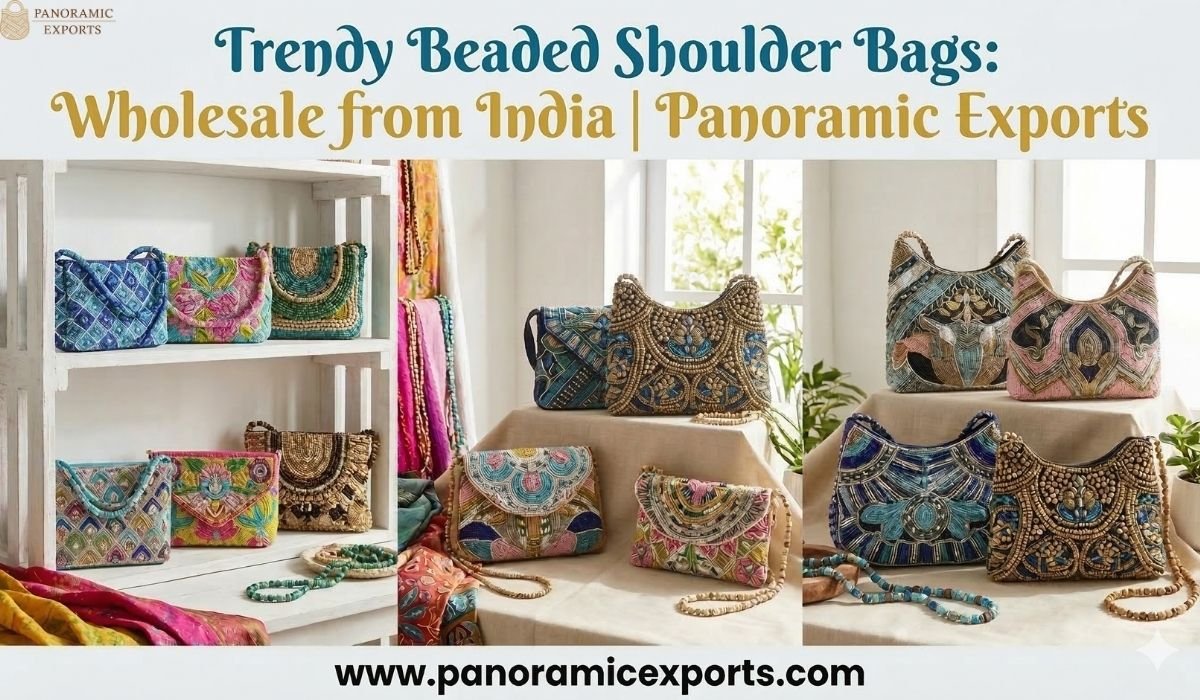
    The retail world in March 2026 is exhausted. Consumers are tired of soul-less, plastic accessories that look like they were squeezed out of a 3D printer. They want something that feels like a human actually touched it. If you’re a boutique owner or a high-volume Amazon seller, you’ve probably figured out that finding a solid Beaded Shoulder Bags Wholesale India partner is the only way to get that authentic “hand-worked” look at a price point that doesn’t kill your margin. You don’t just need a vendor; you need a manufacturing house that knows how to turn a messy Pinterest board into a retail-ready reality.

    At Panoramic Exports, we’ve spent 25 years in the trenches. We’ve seen trends come and go, but the global hunger for Indian beadwork is at an all-time high right now. Whether you’re chasing the “Boho-Luxury” vibe for a New York boutique or prepping a seasonal drop for a global chain, navigating the world of Beaded Shoulder Bags Wholesale India requires a partner who lives in the dust of the manufacturing hubs and knows the artisans by their first names.


    Why 2026 belongs to the “Hand-Touched” Aesthetic

    The fashion cycle has officially swung back to maximalism, but with a massive side of sustainability. The 2026 buyer isn’t just looking for “shiny things”. They’re looking for beaded shoulder bags wholesale India that tell a story. This is the “Human Touch” economy. When a customer picks up a bag and sees fifty hours of intricate Aari work, they aren’t just buying an accessory. They’re buying a piece of art that a machine simply cannot replicate.

    The Shift Toward Boutique Exclusives

    Small boutiques in London and Paris are currently obsessed with the “Indo-Boho” fusion. This has made Beaded Shoulder Bags Wholesale India the primary choice for retailers who want to offer something that isn’t sitting on every department store shelf. Unlike the mass-produced bags coming out of the giant automated factories in other parts of Asia, Indian beadwork has a specific weight, a texture and a “soul”. We are seeing huge demand for glass seed beads mixed with upcycled wooden accents.

    Amazon FBA: The Brutal Reality of Quality

    If you are an Amazon FBA Beaded Bags Supplier, you know that one bad review about “beads falling off” can tank your listing in 24 hours. That is why the back-end technical stuff matters more than the front-end design. In 2026, the winner isn’t the one with the lowest price; it’s the one with the lowest return rate. Quality isn’t a marketing buzzword for us—it’s a survival tactic.


    The Production Line: Where the Grime Meets the Grace

    To understand the value of Beaded Shoulder Bags Wholesale India, you have to look at how they’re made. India isn’t one giant factory; it’s a network of specialized clusters. As a veteran Indian beaded bag manufacturer, we operate right in the center of these hubs.

    Precision in the Noida Facility

    In our Noida unit, we handle the technical side—the structural integrity of the bag. This is where the beaded shoulder bags wholesale India network is the most advanced. We combine traditional Embroidery techniques such as Zardosi with modern industrial sewing to ensure strength and decorative detailing in every bag.

    Sourcing Sustainable “Gems”

    The 2026 buyer is a part-time auditor. They want to know where the Beads came from. We’ve pivoted our production to focus on beaded shoulder bags wholesale India that use lead-free glass and organic cotton linings. If your supplier can’t show you a digital paper trail for their materials, your brand is at risk. We provide that transparency because we know the 2026 compliance audits are coming for everyone.


    Shipping in a Chaotic Global Climate

    You can’t talk about Beaded Shoulder Bags Wholesale India without talking about the logistics headache. As of March 17, 2026, the Strait of Hormuz is a mess. Shipping costs are jumping and “dwell times” at the ports are a nightmare.

    The “Crush Factor” and Humidity

    You don’t just throw beaded bags in a box. You have to account for the “crush factor” and the intense humidity of a sea container. We use multi-layer, moisture-wicking packing. Each bag gets its own acid-free tissue wrap to prevent tarnish. This is why we are a trusted bulk Beaded Purses exporter—we deliver retail-ready goods, not a box of loose beads.

    Honesty About Lead Times

    A lot of beaded shoulder bags wholesale India vendors will lie to you about dates just to get the deposit. We don’t. Because beading is manual, you can’t “overclock” the artisans without the quality dropping. We tell you it takes 60 to 90 days because that’s the truth. We’d rather lose a quick sale than lose a long-term partner.


    Why Panoramic Exports is Your On-Ground Muscle

    When you’re looking for Beaded Shoulder Bags Wholesale India, you’re looking for a partner you can trust with your capital. We are a family-managed house with a global mindset. We bridge the gap between the rural artisan in a village and the high-street buyer in a skyscraper.

    In-Line Inspection vs. Final Inspection

    We don’t wait for the bag to be finished to check it. We do “In-Line Inspection”. Our QC team is on the floor while the beading is happening. If a pattern is a millimeter off on day five, we catch it then—not on day sixty when the container is being loaded. This is why we are the preferred beaded handbags for boutiques partner for high-end designers.

    The Private Label Advantage

    We aren’t just selling what’s in a catalog. We are a design house. You send us a sketch and we turn it into a physical prototype in 15 days. We help you choose the right thread weight and bead caliber so your brand stands for something more than just “cheap imports”.


    Managing the Margins and the Supply Chain

    In 2026, the supply chain is fragile. Raw material spikes can happen overnight. Because we have direct contracts with bead mills and fabric weavers, we can lock in prices. Most Beaded Shoulder Bags Wholesale India vendors are buying from middlemen; we are the source.

    Digital Transparency

    We don’t go “ghost” on you after the money is wired. We use digital tracking to show you photos of your production in real-time. This “Glass Factory” approach is what 2026 buyers demand. We keep you in the loop, so you can keep your customers in the loop.


    Conclusion

    Success in the accessories game isn’t about the lowest price—it’s about the most reliable supply chain. Choosing the right Beaded Shoulder Bags Wholesale India partner means you can focus on your marketing while we handle the grit and grime of the factory floor. At Panoramic Exports, we are the invisible backbone of fashion brands that actually want to grow. Let’s start your next collection today.


    FAQs

    1. What is the minimum order for Beaded Shoulder Bags Wholesale India?

    We usually start at 50 units per design. This ensures our artisans can maintain a consistent “hand” throughout the batch.

    2. How do you handle Amazon FBA prep?

    We offer full FBA labeling and DDP (Delivered Duty Paid) shipping, so you don’t have to touch a single box.

    3. Are the beads used in your bags lead-free?

    Absolutely. We strictly follow REACH and Proposition 65 standards to ensure your bags are safe for all international markets.

    4. Can I get a custom prototype before bulk production?

    Yes, we provide physical samples in about 10-15 days for your final approval.

    5. What is your policy on manufacturing defects?

    We offer a 100% replacement guarantee for any beadwork or stitching errors found during your QC check.

  • Hand Beaded Coin Purse Trends: Eco-Friendly Gems for US Fashion Lovers

    Hand Beaded Coin Purse Trends: Eco-Friendly Gems for US Fashion Lovers

    Hand Beaded Coin Purse Trends: Eco-Friendly Gems for USA Fashion Lovers

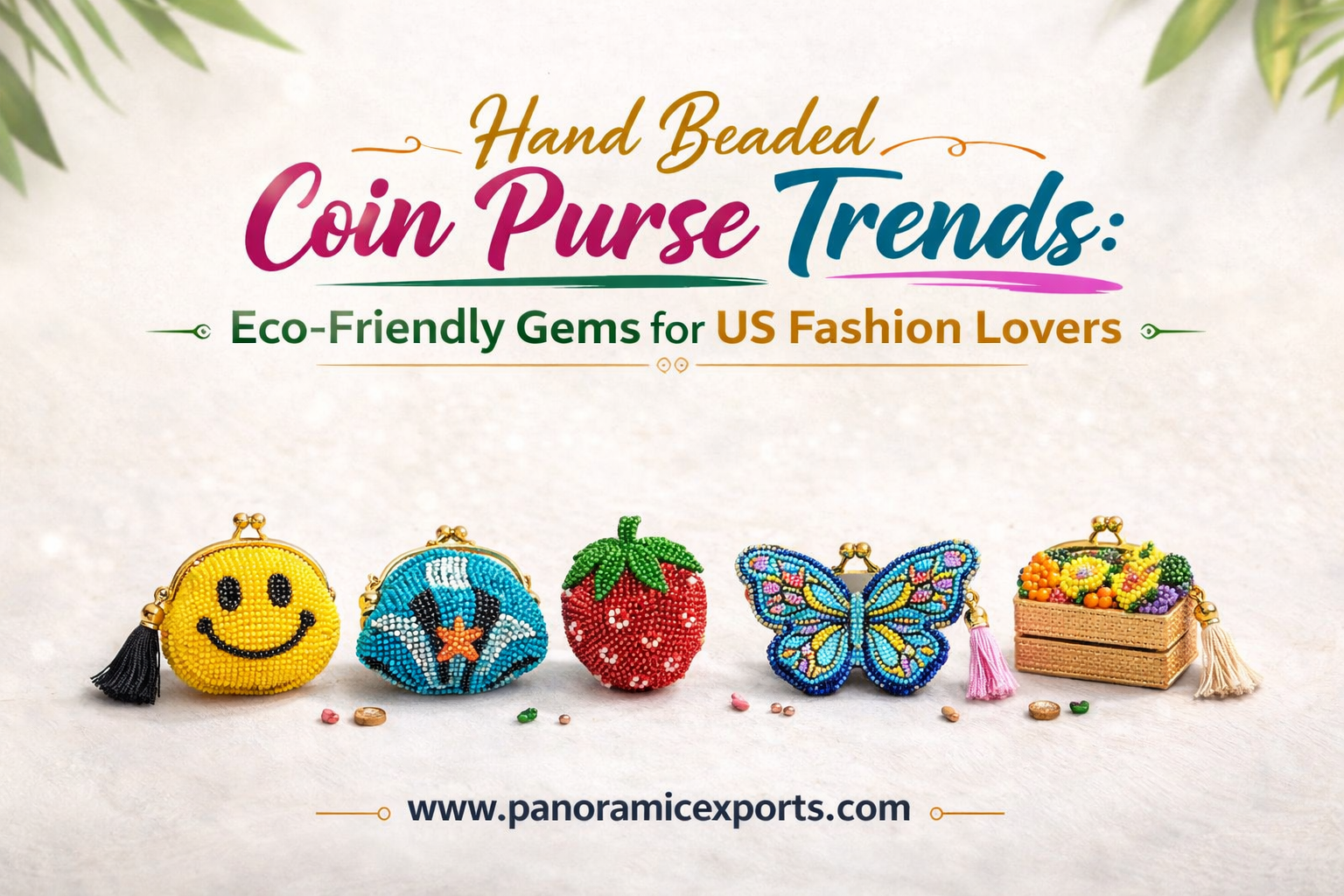
    If you’re walking through the boutique districts of Austin or the creative pockets of Brooklyn right now, the era of “minimalist plastic” is dead. In 2026, the American fashion lover is hunting for “Artisan-Core”—a style that prioritizes the human thumbprint over the machine-made line. At the center of this movement is the Hand Beaded Coin Purse, a small but high-impact “eco-friendly gem” that has officially graduated from the souvenir bin to the high-end luxury shelf.

    At Panoramic Exports, we’ve watched this accessory evolve into a high-texture statement piece. US fashion lovers are no longer satisfied with plastic-heavy trinkets; they want something that sparkles with intent. Here is why the Hand Beaded Coin Purse is the most talked-about accessory in the USA this season and how we are engineering these gems for a sustainable, high-growth market.


    1. The “Gemstone” Aesthetic: Recycled Glass Magic

    When we talk about “gems” in 2026, we aren’t just talking about mined stones. We are talking about the luminous, high-quality recycled glass beads that give every Hand Beaded Coin Purse its unique soul. US fashion lovers are currently obsessed with how these beads catch the California sun—reminiscent of sea glass or raw crystals found on a desert hike in the Southwest.

    By sourcing glass using traditional Beadwork Techniques, we create a product that feels like a piece of history and artisanal craftsmanship. This organic, slightly irregular texture is exactly what the “slow fashion” crowd in the USA is hunting for. It’s a move away from the flat, boring look of mass-produced plastic toward something that feels substantial and alive. When you hold a coin purse, you feel the weight of the craft, making it a true “gem” in any modern accessory rotation.


    2. Sustainable Linings: Beauty Below the Surface

    For the modern US consumer, “Eco-Friendly” is a hollow claim if the lining is cheap polyester. A true “gem” doesn’t hide a plastic interior. That’s why the 2026 trend for the hand beaded coin purse is defined by natural fibers.

    We’ve killed the synthetic liners in favor of organic cotton and sustainable jute. This swap turns the purse from a disposable item into a generational heirloom. Natural fibers breathe, they don’t trap chemical odors and they don’t peel over time. It ensures your coin purse remains functional and soft through years of daily use, whether it’s surviving a humid NYC summer or a dry Colorado winter.


    3. The “Bag-Charm” Hybrid: External Utility

    In cities like Austin and Seattle, the coin purse has moved from the darkness of the bag interior to the outside. It is the new status symbol for the eco-conscious. Fashionistas are now clipping their Hand Beaded Coin Purse onto the handles of their main tote bag, using them as high-texture handbag charms.

    This hybrid trend is huge because of “Modular Utility.” You can unclip your handmade coin purse from your gym bag and snap it onto your evening clutch in five seconds. By using nickel-free, high-shine hardware, we ensure that the beads complement even the most expensive designer leather, proving that “Sustainability” and “High-Fashion” are now the same conversation.


    4. Color Palettes: Desert Earth vs. Neon Sunset

    The US fashion landscape right now is split between two major aesthetics. First, the “Desert Earth” palette—deep rusts, sage greens and clay tones that reflect the landscape of the American West. These colors make the Hand Beaded Coin Purse feel like a piece of the earth itself.

    Second, there is the “Neon Sunset” trend—vibrant pinks and electric blues used in traditional Indian geometric patterns. These are the items that the younger Gen Z audience in the US is buying for their “maximalist” outfits. Regardless of the color, we use botanical-based dyes for our threads, ensuring that even the loudest handmade coin purse remains a planet-friendly choice.


    5. Engineering the “Keep” Factor: Anti-Waste Design

    In the world of sustainability, the most eco-friendly move you can make is to create something that doesn’t break. A hand beaded coin purse that loses its beads after two weeks is just more landfill. At Panoramic Exports, we’ve perfected a “Double-Lock” stitching method that anchors every section independently.

    This means the Beads on your coin purse stay put, even if it’s tossed into a crowded glove box or shoved into a tight back pocket. When you source through us, you aren’t just getting a trend; you are getting a piece of durability engineering. We build these to be “lifetime accessories,” which is the only real way to be sustainable in 2026.


    6. Ethics as the New Luxury

    For the US fashion lover, the “Who Made It?” question is as important as the “What is it?” question. They want to know their coin purse was made by artisans earning a fair wage in a safe environment.

    At Panoramic Exports, we provide that transparency. We share the “Maker’s Story” for our accessories, highlighting the workshops behind the glass. This honesty turns a simple Hand Beaded Coin Purse into a piece of “Ethical Luxury.” When a customer in Chicago or Dallas buys one of our designs, they are supporting a supply chain that respects the human behind the bead.


    7. Micro-Personalization: The Identity Trend

    The final trend for 2026 is “Identity Fashion.” US boutiques are demanding designs that feature zodiac signs, botanical illustrations, or personalized initials.

    We integrate these custom details directly into the beadwork pattern. This turns a generic hand beaded coin purse into a sentimental heirloom. By making the product personal, we increase the “Keep Rate,” which is the most eco-friendly result a brand can achieve.


    Why Panoramic Exports is the Choice for US Trendsetters

    We don’t just “supply”; we curate. At Panoramic Exports, we understand the “American Aesthetic”—that specific blend of bohemian freedom and high-end industrial quality.

    • Sustainable Materials: We lead with recycled glass and organic plant-based fibers.

    • Trend Agility: We turn a Pinterest mood board into a physical Hand Beaded Coin Purse sample in record time.


    Conclusion

    The Hand Beaded Coin Purse is no longer just a small bag for change. It is a statement of intent. By choosing eco-friendly materials and artisanal construction, we’ve transformed this accessory into a 2026 staple for the US fashion lover. At Panoramic Exports, we deliver the “Gems” that the modern consumer is searching for.


    FAQs

    1. Are these beaded coin purses actually eco-friendly?

    Yes, we prioritize recycled glass and organic linings for every beaded coin purse in our sustainable line.

    2. What is the top trend for 2026?

    The keychain hybrid used as an external bag charm is the #1 mover in the US right now.

    3. Can you handle custom branding for boutiques?

    Definitely. We can customize the bead patterns to include brand-specific logos or motifs.

    4. Is the hardware safe for sensitive skin?

    All our hardware is certified lead and nickel-free.

    5. How long is the shipping to the US?

    We use air-freight options that can get your stock to your US dock in 7–10 days.

  • How to Make Beaded Bag Charms?

    How to Make Beaded Bag Charms?

    How to Make Beaded Bag Charms?

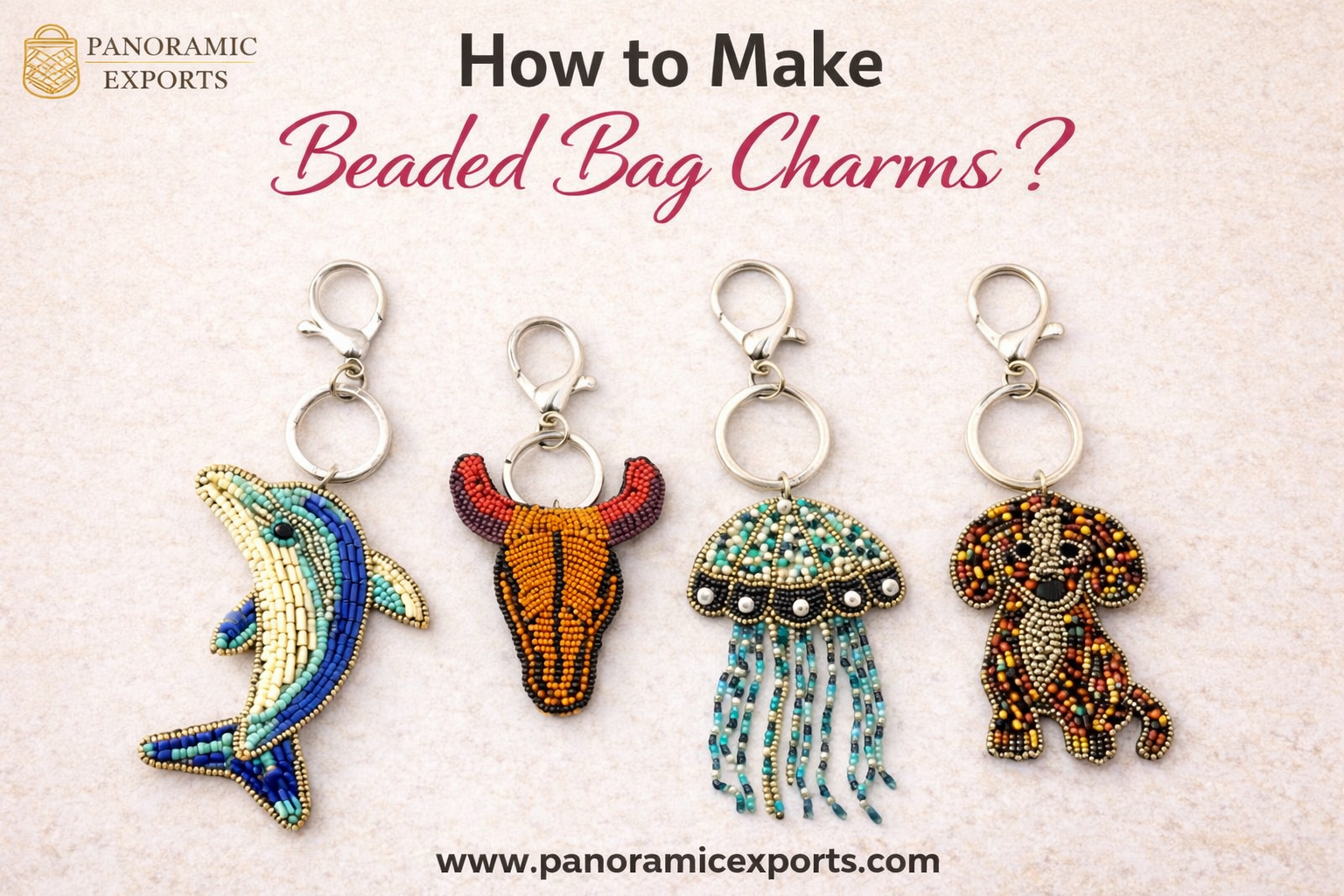
    In the high-stakes world of global fashion exports, a “trinket” is a liability. For a retail buyer in New York or Berlin, Beaded Bag Charms aren’t just accessories—they’re high-margin add-ons that have to survive rough handling, humidity and the legal minefield of international safety laws. If you want to know how to make these at a professional level, you have to look past the “craft” and focus on the engineering.

    At Panoramic Exports, we don’t do “hobby projects”. We do industrial-grade accessory manufacturing. Moving Beaded Bag Charms from an Indian workshop to a global storefront means solving the physics of the stringing material and the chemistry of the hardware plating. Here is the professional breakdown of how we build value into the “small stuff”.


    Step 1: The Foundation and Material Selection

    The most common failure point in beaded bag charms is the core string. If you want to know how to make a product that lasts, you start by throwing away the elastic. Hobbyist suppliers often use cheap monofilament that degrades under UV light and snaps under the slightest pressure.

    For professional global export, we use 49-strand stainless steel wire with a heavy nylon coating. It has the “drape” of silk but the break-strength of an industrial cable. In our workshop, we perform random “Pull Tests”. Every Beaded Bag Charms batch must withstand a 10lb pull without the crimps failing. This isn’t just a quality check; it’s an insurance policy against the “Choking Hazard” recalls that keep US and EU compliance officers awake at night. Exporters often reference accessory durability and small-parts safety guidance issued by the U.S. Consumer Product Safety Commission.

    Step 2: Professional Layout and Design Mix

    A cute bag charms design only works if it feels like a discovery, not a commodity. Plastic-heavy charms feel like toys. A multi-textured piece feels like jewelry. We leverage India’s massive artisanal network to find components that machines can’t replicate.

    When planning how to make the charm, we mix high-shine metallic spacers with “matte” finished Indian hardwoods and handmade glass. This “maximalist” approach to Beaded Bag charms is why our clients can command a premium price. We don’t just “find beads”; we curate a material story that makes a handbag charm feel like a bespoke find, not an afterthought.

    Step 3: The Assembly and Tensioning Process

    How you actually string the beads determines the “drape” of the final product. If the wire is too tight, the charm is stiff and looks cheap. If it’s too loose, the wire shows.

    1. Crimp Placement: We start by securing a high-grade copper crimp bead to the lobster clasp. We don’t just crush it; we use a “forming” tool that rounds the metal so it doesn’t snag the bag’s leather.

    2. The Stringing Sequence: We alternate bead weights. Putting a heavy glass bead next to a light wooden one creates a “rhythm” in the swing.

    3. The Double-Back: At the finish point, we thread the wire back through the last three beads. This “locking” mechanism is essential for Beaded Bag Charms that will be tugged on by customers daily.

    Step 4: Chemical Compliance and Plating

    If your custom bag charm shipment is seized at the border because the “gold” plating has high lead content, your whole season is dead. Many factories cut costs by using leaded alloys. We don’t.

    Every single part of our beaded bag charms is 100% lead and nickel-free.

    • Vacuum Plating: We use PVD (Physical Vapor Deposition) for all hardware. Unlike the “dipped” charms you see in discount bins, this won’t tarnish or flake off on a customer’s $2,000 leather tote.

    • Non-Toxic Hues: Whether it’s artisan glass or carved Indian wood, we verify that all dyes are non-bleeding and REACH compliant. This matters for purse charms that might touch skin or moisture.

    Step 5: Weight and Balance Engineering

    Most people think you just string beads and call it a day. But a professional manufacturer looks at the “Center of Gravity”. If a charm is too bottom-heavy, it swings violently and can scratch the bag’s hardware.

    We engineer the weight distribution so that the charm has a satisfying “clink” without becoming a wrecking ball. This involves calculating the density of each Bead—using heavier glass at the core and lighter wood or resin at the extremities. It’s this level of detail that separates a custom bag charm produced for a luxury brand from something bought at a flea market.

    Step 6: Industrial Sealing and Finishing

    In India’s humid climates, wooden beads can be a nightmare. At Panoramic Exports, we use a multi-step sealing process. Every wooden element in our Beaded Bag Charms is tumbled in a specialized sealant that prevents the wood from absorbing moisture and expanding.

    Similarly, for any leather elements integrated into the handbag charm, we use the same high-end edge paint used in luxury handbags. This ensures that the color doesn’t rub off on the customer’s clothes or the bag itself. We’re not just making purse charms; we’re making durable goods.

    Step 7: Packaging for Retail

    A beaded bag charms order can be ruined in the last mile by bad packaging. We provide “Retail-Ready” solutions so you don’t have to touch the product at your distribution center.

    • Anti-Tangle Mounting: We mount every bag charm on a rigid 350gsm backer card. This prevents the “bead-nesting” that happens in sea containers.

    • Anti-Tarnish Environment: Every master carton includes charcoal-based desiccant strips. This keeps the hardware on your purse charms bright even after 30 days in a humid shipping container.

    • SKU Precision: We handle all barcoding and price-tagging in-house. When the shipment hits your dock, the custom bag charm is ready for the floor immediately.


    Scaling Your Production with Panoramic Exports

    The “India Advantage” isn’t just about labor—it’s about a specialized ecosystem. At Panoramic Exports, we sit at the intersection of traditional Indian beadwork and 2026 global QC standards.

    Our Industrial Edge:

    • Prototyping Speed: We can take a mood board and turn it into a physical Beaded Bag Charms sample in 7 days.

    • Scalable Precision: We manage the MOQs that make sense for your brand, from a 500-unit boutique “drop” to a 20,000-unit national rollout.

    • Ethical Supply Chain: Every handbag charm is made in an audited, fair-wage environment. Transparency is our baseline.


    Conclusion

    In 2026, small accessories carry huge brand weight. Learning how to make professional Beaded Bag Charms is about realizing that every detail—from the wire to the packaging—is a chance to delight a customer. By focusing on durability engineering, chemical safety and retail-ready logistics, we make sure your custom bag charm is a profit driver, not a recall risk.

    At Panoramic Exports, we protect your reputation on the retail floor.


    FAQs

    1. How do you handle color-fastness in these charms?

    We use industrial-grade sealants on all wooden beads to ensure they don’t bleed onto expensive leather, a common fear for handbag charm buyers.

    2. Are the springs in the clasps tested for fatigue?

    Yes. Every batch of lobster clasps for our purse charms is cycle-tested. If the gate tension is mushy, we reject the lot.

    3. Can you provide third-party lab reports?

    Absolutely. We work with certified labs to provide lead and nickel-free documentation for all Beaded Bag Charms bound for the USA or Europe.

    4. What is the maximum weight you recommend?

    We engineer our designs to stay under 100 grams. Anything heavier can cause “handle sag” or put too much stress on a delicate bag’s stitching.

    5. Can we get custom metal branding?

    Yes, we can laser-etch or die-cast your logo onto a metal “signature” tag for every custom bag charm in your collection.

  • How to Make Beaded Handbags?

    How to Make Beaded Handbags?

    How to Make Beaded Handbags?

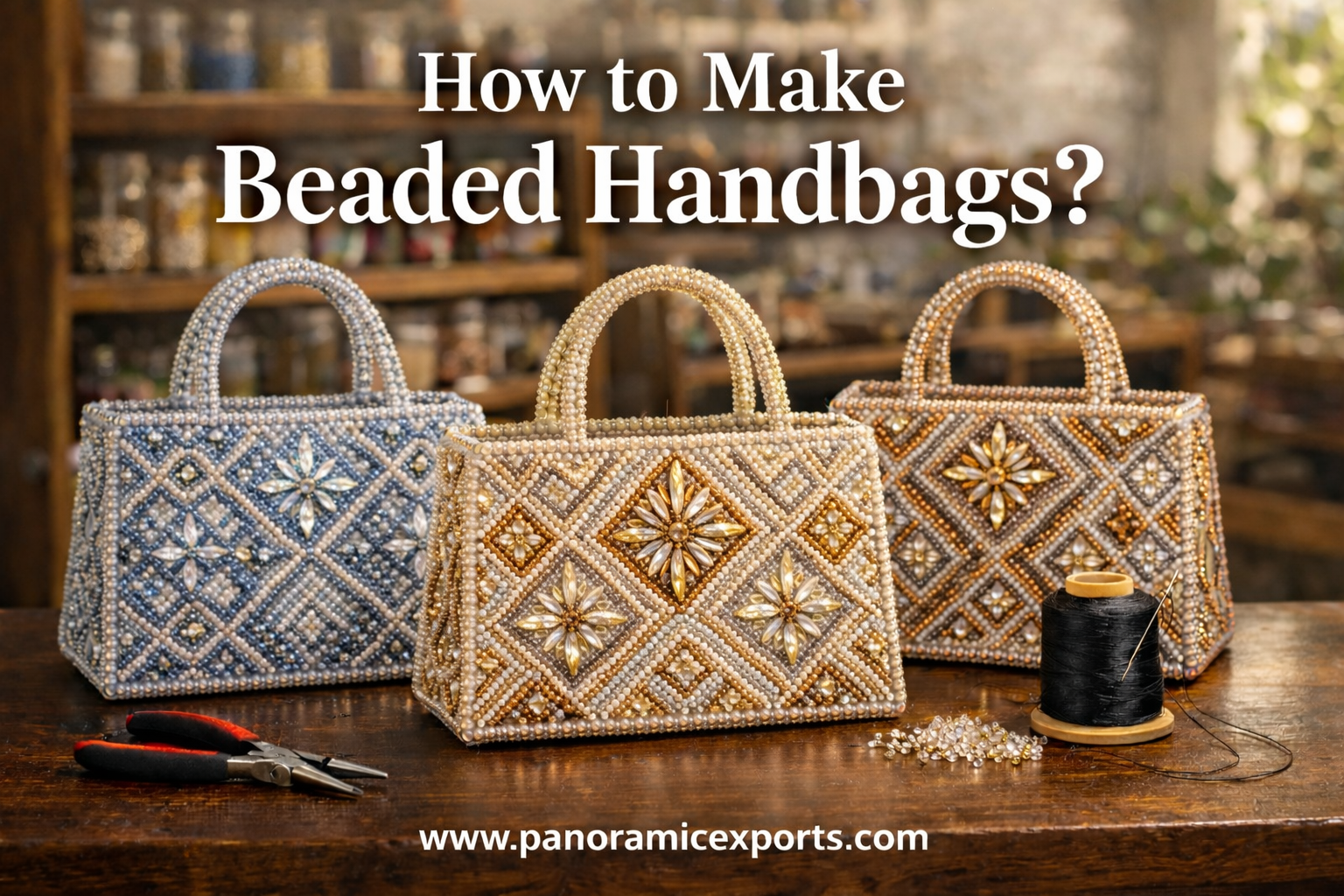
    Look, most people think making Beaded Handbags is just a relaxing afternoon of stringing glass on a line. If that’s your plan, you aren’t making a product; you’re making a mess. In the world of high-end export, a beaded bag isn’t jewelry—it’s a load-bearing structure. You’ve got thousands of glass beads trying to pull themselves to the floor and if your engineering is weak, the bag will look like a sad, saggy sack before it even hits the retail shelf.

    At Panoramic Exports, we treat Beaded Handbags like a construction project. It’s about managing gravity and friction. If you want to build something that actually survives a night out or a global shipping container, you have to stop thinking about “pretty” and start thinking about “structural integrity”.


    The Math Before the Needle

    Before anyone picks up a bead, we’re doing math. Beaded Handbags are deceptively heavy. A standard-sized clutch can easily weigh as much as a small laptop. The material density and durability of the beads themselves also matter, especially when understanding the glass bead manufacturing process that influences overall bag strength. If you just start weaving without a plan, the weight will stretch your thread and by day three, the bag will be two inches longer than you intended.

    We map out the weight distribution on a technical grid. We don’t use standard fishing line because it’s rubbish—it stretches and eventually snaps under UV light. We use a bonded nylon thread or a polymer-coated steel wire. You need something that has zero “creep.” If you want your Beaded Handbags to keep their shape, the foundation has to be as stiff as a bridge cable.


    The Lattice: More Than Just a Pattern

    When we weave a bag at Panoramic Exports, we aren’t just sewing. We are building a lattice. This is the “skin” of the bag and it’s under constant tension. The secret to a bag that feels “solid” rather than “mushy” is the double-pass. Every single bead has the thread running through it at least twice, often three times in the corners.

    This creates a redundant system. If a customer snags a bead on a car door and one thread snaps, the bag stays together. Most cheap Beaded Handbags use a single-pass method. One break and the whole thing unspools like a nightmare. We also hide “anchor knots” every few inches. It’s a pain to do and it slows down production, but it’s the only way to guarantee the bag won’t fall apart.


    The Bone Structure: Frames and Mesh

    If you put a bag on a table and it collapses into a puddle of beads, you failed. To get that high-end, sculptural look, you need a skeleton. For professional Beaded Handbags, that usually means a hidden acrylic box or a reinforced wire mesh frame.

    This skeleton takes the weight so the beads don’t have to. It gives the bag that satisfying “clink” when you set it down. It’s the difference between a cheap souvenir and a luxury accessory. Without a frame, the gussets (the sides) will always buckle inward. You can’t fix that with more Beads; you fix it with better bones.


    The Lining: Don’t Glue It

    This is where the amateurs give themselves away. They build a beautiful Bead exterior and then try to glue a lining inside. It never works. Within a week, the glue fails and the lining is a tangled mess.

    For professional Beaded Handbags, the lining has to “float.” We hand-stitch the interior fabric to the frame, not the beads. This way, when the customer drops their heavy keys or a phone into the bag, the weight pulls on the internal frame, not the delicate beadwork. It’s a “bag within a bag” philosophy. At Panoramic Exports, we use high-denier satin that can handle the friction of the beads without fraying.


    Hardware: Anchors, Not Just Zippers

    The handles and clasps are the highest stress points on any bag. If you just sew a handle onto the top layer of beads, it will rip off. Period. For our Beaded Handbags, we use “D-ring” anchors that are woven directly into the structural wire. The handle becomes part of the bag’s DNA.

    We also run “stress tests” in the workshop. We hang the bags with double the intended weight for 24 hours. If there’s even a millimeter of stretch, the design goes back to the drawing board. This is why Panoramic Exports is the go-to for brands that can’t afford quality complaints. We handle the grit so you get the glitter.


    The Sustainability of Craft: Why Construction Matters

    In 2026, you can’t talk about Beaded Handbags without talking about the lifespan of the product. The world is finally waking up to the fact that “cheap” is actually expensive when the item ends up in a landfill after three uses. When we build a bag at Panoramic Exports, we’re thinking about the ten-year mark, not just the ten-minute mark on a retail shelf.

    A bag built with a floating lining and a reinforced skeleton is, by definition, a sustainable choice. Why? Because it doesn’t break. If a thread is bonded nylon and the beads are high-grade glass, the bag doesn’t degrade. It becomes a vintage piece rather than trash. We see a lot of “greenwashing” in the industry, but true sustainability starts with a needle that doesn’t fail and a frame that doesn’t snap.

    This level of detail is also what protects the artisans. Hand-weaving a structural lattice is an elite skill. By refusing to cut corners with single-pass sewing or cheap glue, we ensure that the craft remains a respected profession. At Panoramic Exports, we aren’t just selling a bag; we’re selling the hours of focus and the technical mastery it took to keep those beads in perfect, rigid alignment. If you want a brand that stands for more than just aesthetics, you have to invest in the engineering.


    Conclusion

    Building Beaded Handbags is a brutal, hand-cramping process. It’s slow, it’s expensive and there are no shortcuts. But when you hold a bag that’s been built with proper tension and a solid skeleton, you feel the difference immediately. It feels like an object of value, not a fragile toy.

    At Panoramic Exports, we aren’t interested in making “fast fashion” junk. We make pieces that are intended to be kept. If you want to know how to make a bag that actually lasts, you start with the structure and end with the sparkle.


    FAQs

    1. Why does my beaded bag look “warped”?

    It’s a tension issue. You’re likely pulling too hard in some spots and not enough in others. You need a consistent “drag” on the thread.

    2. Can I use regular thread for Beaded Handbags?

    No. Cotton will rot and polyester will stretch. Use bonded nylon or coated steel wire if you want it to survive a season.

    3. How do I stop the bottom from sagging?

    You need an internal base plate—usually acrylic or a heavy-duty mesh. Beads cannot support their own weight over a wide area.

    4. Is hand-weaving better than machine-made?

    For intricate 3D shapes, machines can’t touch the precision of a human hand. Machines are for “flat” work; artisans are for “structure.”

    5. How do you clean these Beaded Handbags?

    Gently. Use a soft damp cloth. Never soak them—the internal wire might be rust-resistant, but you don’t want to test the lining’s limits.

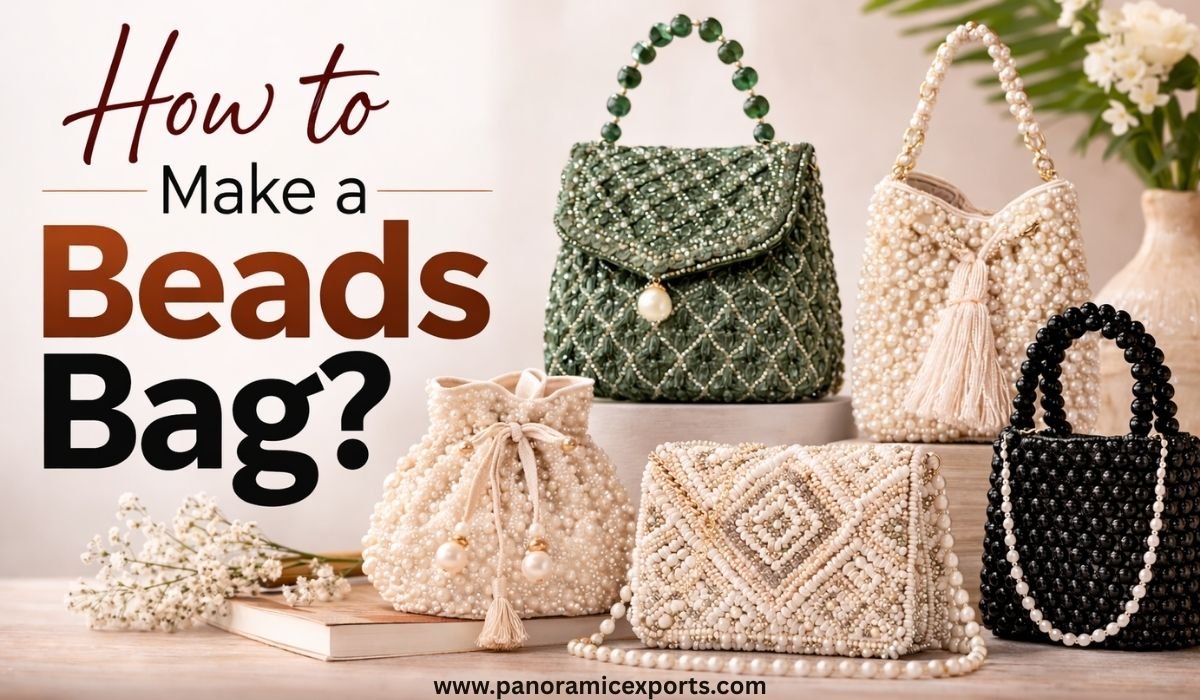
  • How to Make a Beads Bag?

    How to Make a Beads Bag?

    How to Make a Beads Bag?

    Look, making a Beads Bag is basically a marathon for your fingers. It’s the trend that won’t quit because these bags have a tactile, heavy soul that plastic-molded fast fashion can’t touch. But don’t let the pretty colors fool you—this is structural work. If you don’t get the physics right, you’re just making a expensive pile of loose beads. A real bag is all about one thing: tension.

    It’s about that raw, sore-thumb feeling after four hours of pulling nylon tight. You’re fighting the material the whole time. If you go soft on the line for even a second, the whole bag loses its “bones” and starts to sag like an old sweater. You want a Beads Bag that feels like a solid brick in your hand—something that clacks with authority when you set it down on a glass table. That only happens when you commit to the grind.


    Understanding the Anatomy of a Beads Bag

    You have to stop thinking like a jeweler and start thinking like a mason. You’re laying bricks, not stringing a necklace.

    The Beads (Choose Wisely)

    Your choice of bead dictates the weight of your life for the next ten hours. Acrylics are the go-to for that chunky, 90s-style Beads Bag vibe. They’re light enough that you won’t get a shoulder ache. Glass or crystal is the play if you want that high-end “clink” when the bag hits the table. I always suggest 8mm or 10mm rounds. If you go smaller for your first bag, you’ll probably throw the whole project out the window by hour three.

    The Gear You Actually Need

    Forget the stretchy cord from the craft aisle. It’s useless here.

    • The Line: You want 0.5mm clear nylon monofilament. It’s fishing line, basically. It doesn’t stretch and it’s tough as nails.

    • The Count: Grab 1,500 beads. You’ll lose ten under the couch, so overbuy.

    • The Nippers: Use a pair of flush-cut snips. You need to bury the knots inside the beads so they don’t scratch your hands.


    Step-by-Step Guide: How to Make a Beads Bag?

    The “Right Angle Weave” (RAW) is the industry secret. It creates a grid that’s stiff enough to stand up on its own.

    1. The Starting Square

    Cut a length of line about as long as your arm span. Put four beads on. Take the right end of the line, loop it back through the fourth bead on the left and yank it. You should see a tight little square. This is the “seed” for your Beads Bag.

    2. Building the Foundation

    Add two beads to the left string and one to the right. Cross the right string through the last bead on the left side. Repeat. Keep going until you have a flat strip that matches the width you want for your bead bag. If the strip feels floppy, you’re being too gentle. Pull that line until the beads lock together.

    3. Turning the Corner (The Walls)

    Now you have to go vertical. You stop adding to the end and start “hooking” your line into the side beads of the base. This is where the beads handbag starts to feel like a real object. Every time you cross a unit, give the line a sharp tug. Consistency is everything. If one row is loose, the whole bag will sag.

    4. Toughening the Handles

    The handle is the failure point for most DIY projects. Don’t just string beads on a wire. Weave a flat, narrow strap of beads and then “zip” it onto the main body of the beads bag. Once it’s attached, run your thread through the entire handle loop three times. This reinforces the beads bag so it can actually hold a heavy phone without the line snapping.


    What Makes it “Professional”?

    There’s a massive gap between a bag made on a kitchen table and one that sits in a luxury window. Professional-grade work means zero visible knots and zero gaps. In the global trade, this kind of manual labor is respected because it can’t be automated. For those tracking how these artisanal skills contribute to the economy, The World Bank’s trade reports often highlight the value of hand-manufactured exports.

    A pro Beads Bag often uses reinforced internal lines and custom-dyed acrylics that a typical hobbyist just won’t have access to.


    Panoramic Exports: The Industrial Standard

    This is exactly where Panoramic Exports dominates. We’ve taken the soul of the handmade Beads Bag and applied industrial-level quality control to it. Based out of India, we don’t just “make” bags; we produce export-quality accessories that hit the international market with perfect symmetry and durability. We handle the massive orders that individual crafters can’t touch.

    At Panoramic Exports, we focus on the technical side of the craft. We use high-tensile strength lines and premium-grade beads that won’t fade or crack. Our artisans are masters of the “pull,” ensuring every bag has that signature rigidity. Whether it’s a sleek evening clutch or a massive beaded tote, our manufacturing process ensures that the quality stays consistent across a thousand pieces. For us, a bead bag is a piece of precision engineering.


    Conclusion

    Making a Beads Bag is a grind. It’s one bead, one cross-stitch and one pull at a time. There’s no machine that can replicate the specific tension a human hand gives to a bead bag. Whether you’re trying to DIY your own signature piece or you’re a brand looking for the massive scale that Panoramic Exports provides, you have to respect the hours that go into every single weave. It’s slow fashion at its best.

    This isn’t just about throwing together a quick purse; you’re actually building something with enough grit and personality that it refuses to be ignored. When you finally tuck in that last knot and cut the line, you’re holding a solid piece of work that isn’t going to fall apart or look dated by next season. It’s that raw, hand-cramping effort—the kind you can’t fake—that gives a bead bag its real soul in a world that’s already overflowing with hollow, mass-produced junk.


    FAQs

    1. Why does my Bead Bag look crooked?

    It’s almost always a tension issue. You’re pulling harder on one row than the other. You need to “snap” each unit into place with the same force.

    2. What’s the best way to hide the knots?

    Tie a surgeon’s knot, then use your pliers to pull the knot into the center of a bead hole. It should “pop” in and disappear.

    3. Is the bead bag trend over?

    Not even close. The bead bag is a classic because it’s 3D texture. It doesn’t go out of style any more than a pearl necklace does.

    4. Can I use silk thread?

    No. Silk will fray and rot over time. For a bead bag, you need clear nylon. It’s waterproof and won’t stretch.

    5. Does Panoramic Exports do custom colors?

    Yes. Panoramic Exports specializes in matching bead colors to specific brand palettes for wholesale orders.

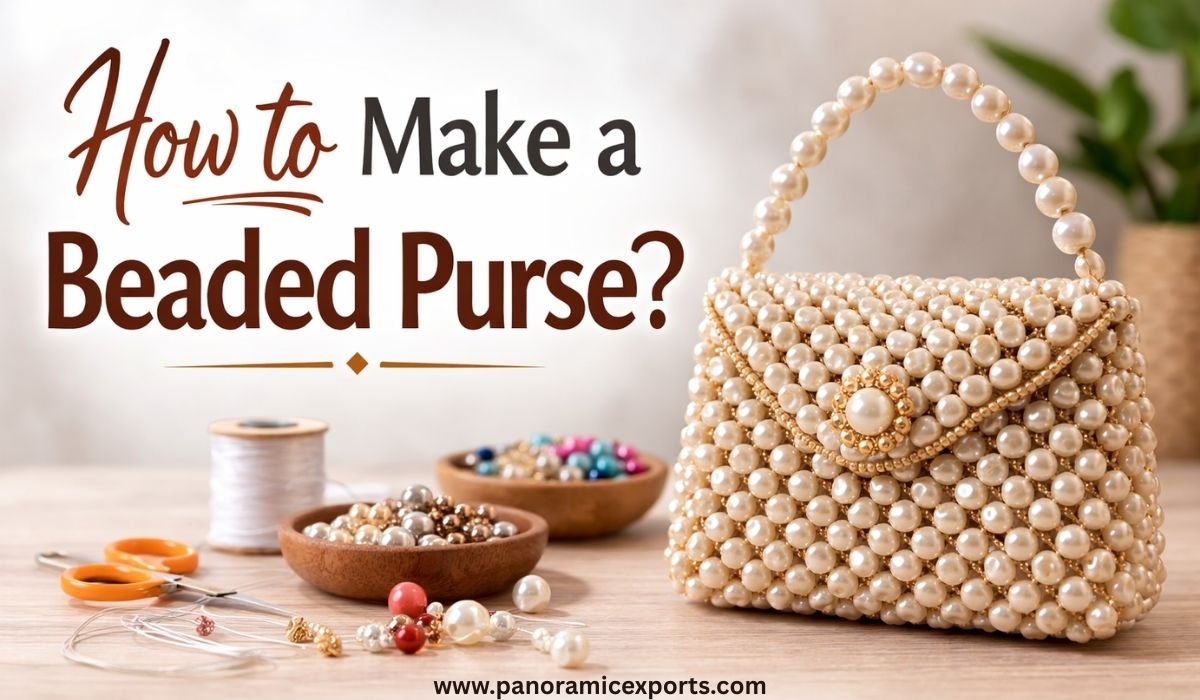
  • How to Make a Beaded Purse?

    How to Make a Beaded Purse?

    How to Make a Beaded Purse?

    Look, making a Beaded Purse is basically a marathon for your fingers. It’s the trend that won’t quit because these items have a tactile, heavy soul that plastic-molded fast fashion can’t touch. But don’t let the pretty colors fool you—this is structural work. If you don’t get the physics right, you’re just making an expensive pile of loose beads. A real Beaded Handbag is all about one thing: tension.

    It’s about that raw, sore-thumb feeling after four hours of pulling nylon tight. You’re fighting the material the whole time. If you go soft on the line for even a second, the whole bag loses its “bones” and starts to sag like an old sweater. You want a Beaded Purse that feels like a solid brick in your hand—something that clacks with authority when you set it down on a glass table. That only happens when you commit to the grind and respect the friction between the spheres.


    The Physics of the Build

    Stop thinking like a jeweler. Start thinking like a mason. You’re laying bricks, not stringing a necklace. If the foundation is weak, the whole Beaded Handbag folds the second you put a heavy wallet in it. The entire structure relies on a geometric system called the Right Angle Weave, a cross-locking beadwork method that creates strong, structured surfaces in purse construction. You can understand the technical weaving process in detail by reading this guide on Right Angle Weave technique.

    Picking Your “Main Character”

    The character of your Beaded Purse starts with the material. Acrylics are the go-to for that chunky, 90s-style vibe. They’re light enough that you won’t get a shoulder ache. Glass or crystal is the play if you want that high-end “clink” when the bag hits the table. I always suggest 10mm rounds for a standard purse. If you go smaller for your first project, you’ll probably throw the whole thing out the window by hour three. The weight of the bead matters because it provides the gravity needed to keep the weave seated properly.

    Essential Tools and Materials for Making a Beaded Purse

    Forget the stretchy cord from the craft aisle. It’s useless for a Bead Purse. You need 0.5mm to 0.6mm clear nylon monofilament. It’s fishing line, basically. It doesn’t stretch and it’s tough as nails. You’ll also need about 1,200 beads—overbuy, because you’ll lose ten under the couch. And get a pair of flush-cut snips. You need to bury the knots inside the beads so they don’t scratch your hands or snag on a silk dress.


    The Construction Reality: How to Make a Beaded Purse?

    We aren’t following a “tutorial” here; we’re following a blueprint. The construction of a beaded purse is a non-linear process that happens in three specific structural planes.

    Constructing the Floor

    The base of your beaded purse dictates the entire silhouette. You start by threading four units onto your line and crossing the ends to create a “cell.” By repeating this horizontally, you create the floor. This section must be exceptionally tight, as it bears the brunt of the interior weight. If the floor of your beaded handbag is soft, the walls will collapse inward the moment you pick it up.

    Rising Vertically

    To move from a flat mat to a three-dimensional beaded purse, you have to pivot. You “link” into the side units of your floor and begin building the walls. This is where the bag starts to gain its characteristic rigidity. If your tension is uneven here, the bead handbag will lean. It’s a slow-motion battle against the tangling of lines and the limits of human finger strength. You’re fighting the material the whole time.

    The Kinetic Stress Points

    The handle and closure are where most DIY efforts fail. To prevent a snap, you have to weave the handle directly into the grid of the beaded purse, distributing the weight across the entire frame. This “deep-root” weaving is what makes a professional beaded handbag last for decades rather than weeks.


    Industrial Excellence: The Panoramic Exports Standard

    While individual crafting is a slow, meditative process, the global market demands a level of consistency that is difficult to achieve in a home setting. This is the niche occupied by Panoramic Exports. As a specialist in the manufacturing and distribution of artisanal goods, our company bridges the gap between traditional Indian hand-weaving and the rigorous demands of international fashion houses.

    At Panoramic Exports, we don’t just “make” things; we manufacture them to withstand the real world. Every Beaded Purse produced by our team undergoes a specific tension-test to ensure the weave is uniform across every square inch. We focus on “Invisible Finishing,” a technique where knots are buried deep within the sphere cores to prevent skin irritation. For boutiques and wholesalers, partnering with our company means access to a level of craftsmanship where every single bead is accounted for. We handle the heavy lifting of production so that the final Beaded Handbag hits the retail shelf with perfect symmetry.


    Conclusion

    The journey of creating a Beaded Purse is a grueling exercise in focus. It is a slow, methodical grind where one missed loop can compromise the entire structure. From the initial layout of the base to the final reinforcement of the straps, making a Bead Purse is about honoring the material and the clock. It’s one Bead, one cross-stitch and one pull at a time.  Whether you’re trying to DIY your own signature piece or you’re a brand looking for the massive scale that Panoramic Exports provides, you have to respect the hours that go into every single weave. It’s slow fashion at its best.

    This isn’t just about throwing together a quick purse; you’re actually building something with enough grit and personality that it refuses to be ignored. When you finally tuck in that last knot and cut the line, you’re holding a solid piece of work that isn’t going to fall apart or look dated by next season. It’s that raw, hand-cramping effort—the kind you can’t fake—that gives a Beaded Purse its real soul in a world that’s already overflowing with hollow, mass-produced junk.


    FAQs

    1. Which thread is strongest for a Bead Purse?

    A clear, non-stretch nylon fishing line (0.6mm) provides the best mix of strength and invisibility for a Beaded Purse.

    2. How many beads does it take to finish a Bead Purse?

    Depending on the size, you can expect to use anywhere from 1,200 to 1,500 beads for a standard beaded purse.

    3. How do I fix a loose row in my bead purse?

    You can’t just “tighten” it from the outside; you usually have to unweave and restart that section of the beaded purse to fix the tension.

    4. Is a beaded purse waterproof?

    The beads and nylon are waterproof, but you should dry a Beaded Handbag thoroughly to prevent moisture from weakening the internal line.

    5. Does Panoramic Exports handle custom purse designs?

    Yes, Panoramic Exports works closely with global designers to manufacture specific, high-quality purse patterns for international markets.

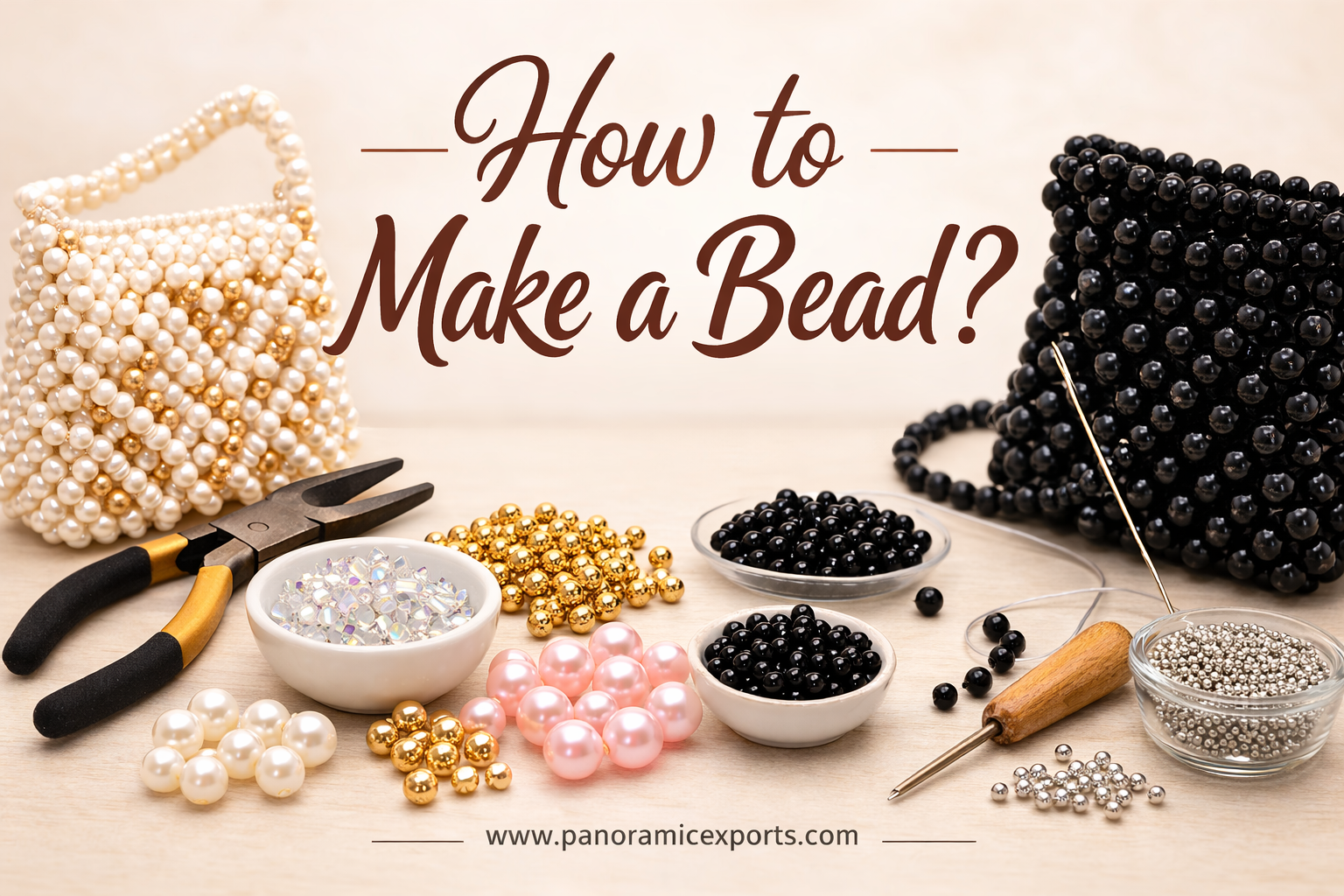
  • How to Make a Bead?

    How to Make a Bead?

    How to Make a Bead?

    There’s a real, almost hypnotic magic in the way a high-end bag rattles and catches the light. When you pick up a signature piece—whether it’s a delicate vintage clutch or a bold, oversized tote—you aren’t just holding a simple accessory; you’re carrying a mosaic made of thousands of tiny, individual stories.

    At Panoramic Exports, we’ve moved past seeing the Bead as just a shiny bit of glass or plastic for decoration. To us, it’s a structural “brick.” In the intense world of international fashion, every single unit has to be engineered with the same precision you’d expect from high-end machinery. It’s this technical obsession that separates a cheap, one-season trinket from a true fashion heirloom that you’ll want to keep forever.


    Picking the Right Materials for Your Bag

    To build a bag that actually sets a trend, you have to start with the right foundation. We pick our materials based on how they play with the light and how much weight they can actually carry once you throw in your phone, keys and wallet.

    • Glass Seed and Bugle Varieties: These are the workhorses of luxury embroidery. To make these, silica is melted down at crazy-high temperatures. They are perfect for those flat “Staud-style” patterns because their uniform shape keeps the bag surface feeling totally smooth.

    • 3D “Berry” and Chunky Baubles: One of the biggest vibes this year is the “Tactile Tote”. Many of these bold styles are influenced by the History and Evolution of Beaded Handbags, where designers first experimented with sculptural bead textures and statement silhouettes. We use huge, 14mm units that give the bag a bumpy, sensory feel. They offer a great grip and a bold, rebellious look that pops in flash photography.

    • Crystal Bicones: For evening wear, the crystal Bead is the undisputed king. These are cut with tiny, sharp facets to bounce light in every direction. When a bag “glows” across a dark restaurant, it’s usually because of these precision-cut angles.

    • Acrylic and High-Density Resins: For those massive totes that carry your whole life, glass can be too heavy. That’s where resin comes in. It can look exactly like marble or bone but stays light enough to carry all day without a backache.


    The Workshop Secret: Step-by-Step Production

    Making a professional component for the export market is a world away from a DIY craft kit you’d find in a hobby store. It’s a disciplined process that ensures every piece is a perfect clone of the last.

    1. Melting the Color In: Everything starts in the furnace. We heat the material until it’s liquid and fuse the dye directly into the molten core. This means the color is permanent. Unlike cheap versions that peel, a “fused-color” Bead stays bright for years.

    2. The Perfect Hole: The molten goop is drawn through a machine to create a long, hollow tube. This is where we form the “aperture.” In professional bag making, that hole has to be perfectly centered. If it’s even slightly lopsided, the whole bag will pucker.

    3. Precise Slicing: Those long tubes are cooled and fed into high-speed cutters. Every unit is sliced to the exact same millimeter. This consistency is what allows an artisan to weave a bag that feels as fluid as silk.

    4. The Smooth-Down: Freshly cut pieces have sharp, nasty edges. To make the bead “thread-safe,” we put them in a centrifugal tumbler. This rounds off the edges and polishes the inside of the hole so it doesn’t “saw” your thread in half during daily use.


    Why a Smooth “Friction-Free” Interior Is Everything

    If you’ve ever had a bag suddenly fall apart while you were out, you’ve likely experienced “thread snap.” It’s the most common reason cheap beadwork fails and it usually happens because the manufacturer took a shortcut on the parts you can’t see. When a bag has a rough, unpolished center, the hard material acts like a tiny saw. Every time you walk and the bag shifts against your hip, that jagged edge is slowly grinding away at the internal string.

    At Panoramic Exports, our “Secret Sauce” is a obsessed focus on that internal finish. We make sure every single Bead is fire-polished on the inside to create a slick, friction-free tunnel for our industrial-strength threads. By making sure the hardware actually “breathes” with the movement of the bag rather than biting into it, we can comfortably promise that our pieces will hold a heavy smartphone and a stuffed wallet without the disaster of a sudden mid-day snap.


    The 2026 Style Guide: Winning Looks

    Why is this craftsmanship the current “it” item? It’s all about a “Pop of Personality.” In a world of boring “Quiet Luxury,” an embellished bag is where you finally get to be a little loud.

    • High/Low Contrast: Try rocking a glitzy crystal Bead Bag with an oversized, distressed leather jacket.

    • The Retro Remix: Taking 1920s-style elements and putting them on a modern, geometric “bucket bag” shape.

    • Eco-Glam: Using a recycled glass unit to satisfy the massive demand for sustainable luxury.

    Feature Cheap Market Alternative Panoramic Exports Standard
    Coloring Surface Painted (Peels) Fused Core (Permanent)
    The Hole Sharp & Rough Polished & Smooth
    Consistency Wonky Sizes Digital Calibration
    Durability Cracks Under Pressure Load-Tested

    Panoramic Exports: Crafting the Future of Accessories

    At Panoramic Exports, we believe the journey of a thousand miles begins with a single, perfect Bead. Based in India’s most skilled artisan clusters, we’ve spent years balancing traditional handcraft with modern industrial standards. We don’t just assemble bags; we engineer them from the ground up.

    Our commitment to quality means we oversee every step. From the initial melting of the base material to the final hand-stitch, we ensure our products meet the “export-grade” benchmarks required by luxury boutiques in London, New York and Tokyo.


    Conclusion

    At the end of the day, a small component is only as good as the hands that crafted it. Whether it’s the shimmer of a seed Bead or the bold statement of a resin bauble, these materials are the heartbeat of modern fashion. We don’t just manufacture them; we make pieces that become part of your favorite memories. When you invest in a work of art, you aren’t just buying a bag—you’re buying a legacy.


    FAQs

    1. Which material is most durable for daily wear?

    A “fused-color” resin or fire-polished glass Bead is best because they resist scratches and oils.

    2. Why are “Berry” silhouettes trending right now?

    These 3D sculptural shapes provide a tactile, knobby texture that adds a layer of unique personality to any bag.

    3. Can I use standard craft store supplies for professional bags?

    No, because every export-grade bead must be digitally calibrated to ensure the weave tension remains perfectly even.

    4. Will a heavy weight eventually snap the bag handles?

    We prevent this by using load-tested handles and mixing heavy glass with lightweight acrylic to keep the structure secure.

    5. Are your manufacturing materials eco-friendly?

    Yes, we create “Green Luxury” by using recycled glass in our production to protect the planet.